Showing posts with label food and wine. Show all posts

Monday, October 28, 2024

COPPO WINERY 2023 CHARDONNAY "COSTEBIANCHE" x VEGETARIAN PUNJABI FOOD


This month we had a bonus event at the World Wine Travel group - #worldwinetravel - thanks to a generous offer from Coppo 1892 winery to sponsor our wines. Coppo is a winery dating back to 1892 but it is also a UNESCO World Heritage Site (2024) in Monferrato, Piemonte, Italy. It is Q4 and nearly year-end so with everyone's life and travel schedules we did not have a chat for this bonus event. But the list of (and links to) all of us who've written about Coppo wines is at the end of this post so do scroll over to browse each article and be inspired!

COPPO WINERY

In Piemonte, spreading over 85 hectares across Monferrato and Langhe, Coppo winery has been in operation since 1892, registered as a historic enterprise with uninterrupted activity in the same sector since they started. Their subterranean tufa limestone cellars at a depth of 40 m., were likely excavated in the 18th century for use as small storage cellars with subsequent expansion leading to their current area extending over 5,000 sq. m. Since 2024, these impressive and ethereal underground cellars have earned the honour of being listed as a UNESCO World Heritage Site. The vast underground network of spaces is used as cellars for Coppo wines, but it is also an engineering marvel, a look into the geology of the region, and a glimpse into œno-architecture. Don't miss a chance to visit Coppo the next time you're in Piemonte!

https://www.coppo.com/en/vineyards/

For many years Coppo has been committed to sustainability and followed organic and biodynamic techniques. Since 2001 they have officially committed to integrated agriculture and agronomic principles with the aim of having a reduced environmental impact.

THE WINE AND THE FOOD

2023 "COSTEBIANCHE" CHARDONNAY, PIEMONTE DOC
100% Chardonnay
ABV 13.5%
SRP $29

The "Costebianche" Chardonnay gets its name (white slopes) from the white limestone hills of the vineyard and surrounds. The grapes grow in calcareous clay marl soil and are hand-harvested after careful selection, and ater the initial soft pressing, they are partly fermented and aged on fine lees in barriques and partly in stainless steel vats. 

Looks: clear, straw yellow

Nose: lemon, white flowers, faint hint of pineapple

Palate: Echos the nose, but also has a fresh savouriness and a creamy edge. A very light but refreshing and juicy wine with a medium finish.

Pairing: We had the Costebianche Chardonnay with two Punjabi vegetarian dishes: chana jor garam and mattar paneer. Having just returned from a month of work in Hawai'i, cooking anything elaborate was out of the question. But after a month of all the tropical fruit and Ahi poké and rice in HI, as much as I had relished the fresh tuna everyday, I was also craving familiar Indian flavours. So we settled for take-away from the one restaurant near us that makes real Punjabi food that isn't loaded with cream (which is lavishly used in the West but never in India) while being devoid of proper flavour.

And in the pantry I found a packet of flattened Indian chickpeas that are used for chana jor garam, a classic street snack around most of India. It couldn't be easier to make - mix together the flattened chickpeas, diced onion and green chillies, chilli powder, chopped coriander, a bit of lemon juice, rock salt, chaat masala.

We started off with snacking on the chana jor garam paired with the Chardonnay. That was a hit! The lemon juice, rock salt, chaat masala, and earthy chickpeas were perfect with the citrus and faint hint of pineapple in the wine. The wine elevated the chana jor garam which in turn made the wine taste juicier. I would absolutely pair the two again.

Then we went on to the main meal of mattar paneer (peas and paneer) cooked in a complex, mildly spiced sauce garnished with cream and redolent with flavours of typical North Indian spices. We had it with naan and pickles. The mild but complex mattar paneer, slight tang of the pickles, and neutral naan with the Chardonnay were excellent, although we enjoyed the wine with the chana jor garam much more.

[Pickles play a significant role in Indian culinary tradition and are prized for their balanced flavour but also their role in digestion and gut health. Every region has it's own specific kind of pickles made with whatever vegetables or fruits are in season. Typical pickles of Punjab have mangoes, carrots, turnips, lemons, and cauliflower in any combination, seasoned with nigella seeds, mustard oil, and other seasonings.]

I've talked about the Coppo wines that I'd received but we all received different wines from the great array of wines Coppo makes. See what the other writers sipped, savoured, and talked about below.

Sunday, October 15, 2023

AMERICAN MERLOT MEETS KASHMIRI FOOD


October is usually MerlotMe month in the US, and the #WinePW group has a Merlot-centric event although not an official MerlotMe one. Our host this month is Camilla Mann from Culinary Cam who also graciously arranged for two samples each for a few of us and wrote a Merlot preview teaser. We will meet on Twitter/X on Saturday, 14 Oct at 8 AM PST as usual so come over and look for or join in under #WinePW. The list (and links) of all of us who've written about Merlot is at the end of this post so do scroll over to browse each article and be inspired with some unique pairings!

Samples or not, opinions, as always are all mine.

KASHMIRI PANDIT FOOD

In India, there's no concept of "Indian" food. We refer to the overall region from where the cuisine is, e.g. Kashmiri, Bengali, Punjabi, Rajasthani etc. food, or sometimes, more granularly, by subregion, town, or community. E.g. Konkani, Tamilian Brahmin, Saraswat Brahmin, Jain, etc. food. Even though overall the cuisine of the Indian subcontinent is rooted in the texts of Ayurveda there are nuances and vast differences in the cuisine of each state based on regions, subregions, ingredients, weather, seasons, geography, and each community's cooking style. Even the herbs and spices vary. Also, although we use countless spices and herbs, it's not as if all of India starts eating chillies the moment they wake up - our food is spiced with spices, it is not spicy. Chillies did not exist in India until the 15th century so.... 

And so, just like every other state in India, Kashmiri food is quite unlike any other cuisine of India. In Kashmir, a cold mountainous Himalayan state full of valleys and lakes, the main herbs and spices are asafoetida, Indian bay leaves, various types of Indian cardamom, black pepper, long pepper, Indian cinnamon, cloves, fenugreek seeds, dried ginger, fennel seeds, Kashmiri shallot, to name just a few, and then since ~1498, Kashmiri chillies, which are medium spicy and of a deep but bright red colour. Cockscomb flower, alkanet root, and saffron are also used, for both, flavour and colour. And dried fruits and nuts are also used in a number of dishes as are lotus root and bottle gourd (vegetables), and yoghurt.

Kashmiri Pandits are the native inhabitants of Kashmir and because of its location it's a place that has been invaded multiple times throughout history. Pandits are Brahmins/Hindus and large numbers have been forcefully converted to Islam, by invading Persian and other Muslim armies. The ones that remained have been victims of genocide by Muslims or forced out to other parts of India and the world, as recently as 1990. However, they have taken their culture and cuisine with them. Unlike many Brahmins, Kashmiri Pandits do eat meat (usually lamb/goat) and freshwater fish, because that is what is available when vegetables are not, and like all Brahmins, they do not eat garlic and onions. In fact, some of the most exquisite Kashmiri Pandit dishes are meat-based. With lavish use of aromatic herbs and spices, Kashmiri Pandit cuisine is particularly well suited to enjoying with wine.  

MERLOT IS MERLOT, NO?

No, luckily. Merlot is originally French (from Bordeaux) and is a cross between Cabernet Franc and Magdeleine Noire des Charentes. It is not half as finicky a grape as Pinot Noir and is grown in every wine-growing region of the world including, these days, China. Merlot was originally - and still is in the Old World wine regions - a blending grape, providing lush fruit and a full body, with low tannins and low acidity to a wine. With aromas/flavours of blackberry, black cherry, violets, mint, and chocolate. And vanilla and baking spices (if aged in new oak).

Even with the same grape, Merlot styles vary vastly around the world depending on soil, climate, and winemaking. Two main Merlot wine areas in the US are California and Washington state. In California, generally Merlot from Napa (or any other warm climate/Valley region) is higher ABV, very fruit forward, jammy, and the ever-present baking spices due to aging in new oak. Coastal or higher altitude CA Merlot on the other hand, is higher acid, not cloyingly fruit-forward, and layered.

In Washington state, Columbia Valley produces the largest quantities of Merlot (some of it very good quality) but some of the exceptional Merlot comes from Walla Walla, Red Mountain, and Horse Heaven Hills in WA. In general, compared to CA, WA Merlot has higher tannin, crisp acidity, and is not overly fruit forward or jammy. Both can pair quite well with a variety of cuisines but because it is more complex, WA Merlot offers much more flexibility in food pairings. 

MERLOT AND KASHMIRI PANDIT FOOD
2020 L'ECOLE NO. 41 MERLOT, COLUMBIA VALLEY
82% Merlot, 15% CABERNET FRANC, 2% MALBEC, 1% PETIT VERDOT
ABV 14.5%
SRP ~$27

Established in 1983, L'Ecole No. 41 is a third generation artisan winery based in a historic schoolhouse in the Walla Walla Valley, WA. They make "premium" wines with the typicity of Washington state (climate, soil, etc.) but it is also their masterful winemaking that results in wines with excellent structure, acidity, colour, and balance.

The grapes for this wine were hand-harvested, crushed, and fermented in stainless steel before being aged in small oak barrels (15% new oak). Greater than the sum of its parts this blend includes grapes from at least 6 different vineyards and has the broader Columbia Valley designation, but it has a vibrant crisp acidity, and is complex and balanced. This wine is delicious!

Looks: deep purple

Nose: dark fruit - plum, black cherry, dried red roses, faint earth, and cedar

Palate: Echos the nose, and also has a cola note on the mid-palate. Smooth but firm tannins, juicy medium+ acid, and a long, elegant finish. Overall, very reminiscent of an Old World Merlot blend.

2022 GOLDSCHMIDT, GUIDESTONE RISE VINEYARD CHELSEA, ALEXANDER VALLEY
100% Merlot
ABV 14.5%
SRP ~$25

The Goldschmidts are originally from New Zealand and now based in Sonoma County. The whole family including the 5 grown kids are actively involved in the winery - a true family enterprise. This winery is new to me but I am very much looking forward to trying their other wines and maybe visiting the winery as well.

Looks: deep purple, nearly opaque

Nose: dark fruit - blueberry compote, ripe cherries, stewed prune plums, maybe baking spices

Palate: Echos the nose, and is very fruit forward. Supple tannins as you'd expect in a Merlot, medium acid. Overall this Goldschmidt Chelsea Merlot is a fleshy wine with a long enough finish that, after at least 5 years in the bottle would maybe calm down enough to pair seamlessly with complex food. 

Pairing: We had the 2020 L'Ecole No. 41 and the 2022 Goldschmidt Chelsea Merlots with Kashmiri Pandit food. The comparatively low tannins in Merlot combined with it's fruit forwardness and plush mouthfeel pair very well with Kashmiri food. Of the two, the L'Ecole was exceptional with the food. Kashmiri Pandit food is very aromatic and complex thanks to the variety of fresh and dried spices, many of which are similar to the baking spices note in (good, well made) American Merlot. Because it was a blend rather than 100% Merlot, the acidity, juiciness, and complexity of the L'Ecole No. 41 was a perfect complement to the food. Both wines paired splendidly with the food... hard to say whether the food bolstered the wines or vice versa, but L'Ecole was a clear winner.

THE FOOD

We had mutsch, al yakhni, and ghee-roasted Basmati rice (descriptions below). We also had roasted potatoes... not exactly an Indian ingredient at all, but I needed to use them up. 

The dishes are: Mutsch (hand-formed lamb kebabs) in a sauce of mustard-oil tempered spices - Indian bay leaves, cloves, Indian cinnamon, black cardamom, and powdered dry ginger-fennel seeds-Kashmiri chillies, with Kashmiri garam masala (a highly aromatic powdered spice mix always added to a dish as a finish). Al yakhni, bottle gourd in a fragrant sauce of cloves, green cardamom, cumin, and powdered dried ginger and fennel tempered in mustard oil, cooked in yogurt, and finished with Kashmiri garam masala. Ghee-roasted Basmati rice is exactly that. Basmati rice soaked for 1 - 24 hours, drained and sautéed in ghee (NOT clarified butter, please), and cooked. 

I've compared the two starkly different American Merlot samples I received, and to be really wowed see what the other #WinePW writers paired with Merlot.

Friday, February 4, 2022

JUST NOW DISCOVERING OLTREPÒ PAVESE WINES


In February the Italian Food Wine Travel group #ItalianFWT explored wines from the relatively less known region of Oltrepò Pavese in northern Italy. Our host Susannah Gold graciously sent some of us samples to review. Two of the wines sent for this review were samples but as always, wine tasting notes and opinions are unbiased and my own. Do read the invitation post here and remember to join us on Saturday, 5 February at 8 AM PST on Twitter at #ItalianFWT to hear about who knew what and what they thought.

THE REGION
  
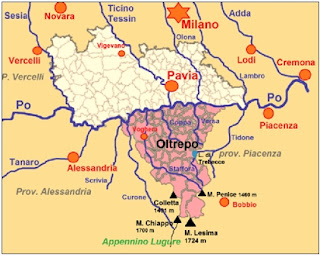
https://www.champagnesparklingwwc.co.uk/messy-pavese/
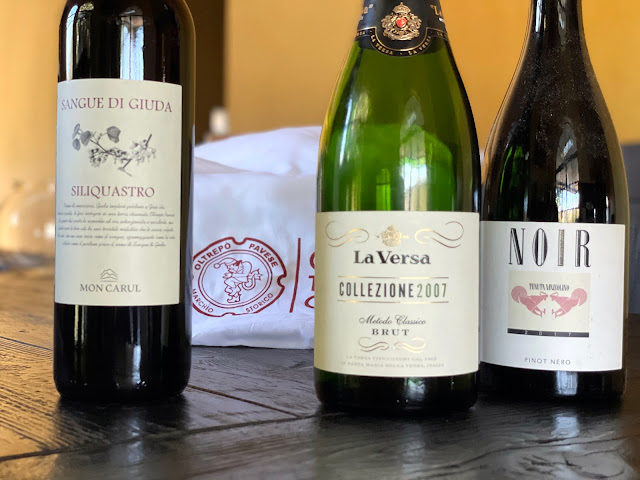
Oltrepò Pavese DOC (Pavia across the (river) Po in Lombard) is in Lombardy, Italy, centred around the village of Pavia. It is known for its classic method sparkling wines of the appellation Oltrepò Pavese Metodo Classico DOCG made primarily from Pinot Nero and still wines made from other international grape varieties, as well as a higher residual sugar wine called Sangue di Giuda (blood of Judah) made from Italian grapes Barbera, Croatina, and Uva Rara. With an ABV hovering at less than 10%, Sangue di Giuda is an excellent choice for an apéro paired with a paté and fruit. The rich soil combined with the closeness to the River Po gives the region an excellent terroir and incredible wines at an incredible QPR. I really wonder about other wine regions that are hidden gems in Italy! 

By a fortuitous coincidence, the Slow Wine tasting in San Francisco was in late January where M and I got to dive deeper into Oltrepò Pavese and met the lovely Director and Press from the Consorzio Tutela Vini Oltrepò Pavese. We hit it off almost instantly and they were delighted to know that I was new to Oltrepò wines. We went right when the event began but the wines were late so we had plenty of time to talk. They insisted we taste everything they thought would be interesting to us and after an animated tasting of almost all their wines they sent us off with a bottle of Sangue di Giuda. If you want to know more about Oltrepò Pavese wines visit them here

THE WINE AND FOOD

LA VERSA 2019 + STUZZICHINI + SPUNTINI (SNACKS + SMALL BITES)
85% Pinot Nero, 15% Chardonnay
ABV 13%
SRP ~$28 | SAMPLE

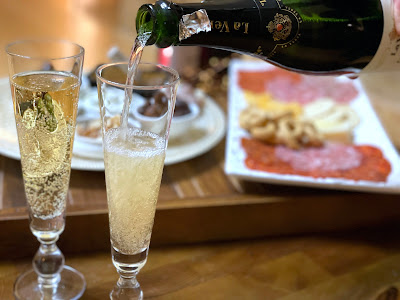
Having spent 144 months on the lees, this wine was an excellent example of Oltrepò Pavese Metodo Classico DOCG wines.

Looks: bright yellow with flecks of gold and fine racy perlage

Nose: brioche, red fruits, cooked stone fruit

Palate: Echos the nose, but also has warm yeasty notes of brioche and a faint saline mineral edge. Racy and persistent bubbles, a very well structured intense and elegant wine with a delicious, long finish. 

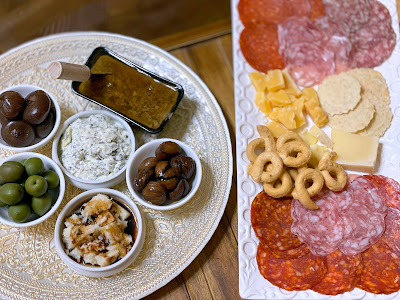
Pairing: We wanted a variety of flavours with this wine so we agreed to have them all! We enjoyed this wine with honey-soaked chestnuts, a black pepper paté and garnishes, Parmigiano Reggiano drizzled with aged balsamic vinegar, salami Varzi and others, 3 year Gouda and a Grana Padano, olives, and an assortment of crackers, grissini, and other bread-y things. We loved each and every single pairing. The chestnuts, salami Varzi, Grana Padano, and the Parmigiano Reggiano with aged balsamic vinegar are definitely traditional regional matches for Oltrepò Pavese wines, but really enjoyed snacking on it all. Sharing always makes everything taste much better, I think! The next time we would pair this with a borlotti bean risotto, another Pavese classic. 


Oltrepò Pavese was new to me but I'm sure some of the other writers are familiar with it so see below and read what everyone tasted, enjoyed, and reviewed!
  • Our host Susannah at Avvinare, talks about “Wine Treasures To Be Found in Oltrepò Pavese."
  • My discovery of this region is here on Keep the Peas where I talk about “Just Now Discovering Oltrepò Pavese Wines"
  • Camilla from Culinary Adventures with Camilla adds Second Pours of Oltrepò Pavese Wines with Braised Short Ribs and Puff Pastry”
  • Linda from My Full Wineglass brings “Flying under the radar with an Oltrepò Pavese sparkling rosé”
  • Terri from My Good Life dishes about “Stone Crabs with Oltrepò Pavese.”
  • Martin from Enofylz showcases “A Taste Of The Unsung Wines of Oltrepò Pavese”
  • Deanna from Winevore posts “Wine for the Priest! from Oltrepo Pavese, Italy”
  • Jeff from Food Wine Click! waxes about the “Surprising Wines of Oltrepò Pavese”
  • Rupal from Syrah Queen post “Oltrepò Pavese Wines -One of Italy’s Best Kept Secret”
  • Gwendolyn from Wine Predator showcases “2 Pinot Nero from Oltrepo’ Pavese #ItalianFWT”
  • David from Cooking Chat reflects on “Tasting and Pairing with Oltrepo’ Pavese Wines” 
  • Wendy from A Day in the Life on the Farm checks out “Cheesy Vegetable Lasagna paired with Oltrepo Pavese Wine”
  • Liz from What’s In that Bottle suggests we “Check Out “the Other Side of the Pó” for Tasty Italian Wines “
  • Jennifer from Vino Travels adds “Pinot Nero in Abundance in the Oltrepò Pavese”
  • Lisa from The Wine Chef writes “Off The Beaten Path: Oltrepò Pavese, A Wine Region to Know About.”


Saturday, February 27, 2021

BARTENDER'S CHOICE FROM PRIORAT


This month - February 2021 - the World Wine Travel group is exploring the wines of Catalonia, Spain. Between reds, whites, and Cavas coming from this corner of Spain, there's a vast variety of wines to choose from for any occasion and we had a field day deciding on a wine for this review before ultimately settling on a unique wine from an equally unique part of Catalonia. See the overview in host Susannah's preview post and join us on Twitter under #WorldWineTravel on 27 February 2021 at 8 AM PST to talk about all things Catalan wine.

CATALONIA (CATALUNYA) + PRIORAT
Image: Catalonia, Spain. indigowine.com
Catalonia is in the northeast corner of Spain bordering France to the north and the Mediterranean sea to the east. There are four Catalonian provinces, of which Barcelona might be the most readily known globally.

Priorat is in Tarragona province in  southwest Catalonia, however, and is a Denominació d'Origen Qualificada (DOQ) for Catalan wines produced in Priorat county. The DOQ covers 11 municipalities that primarily produce intense, full-bodied red wines, and was relatively obscure to the wine world until the 1990s.

Priorat DOQ includes the valleys of the rivers Siurana and Montsant, and vineyards are planted on terraced slopes at altitudes between 100m and 700m above sea level. Priorat summers are long, hot and dry while winters are cold with occasional frost, hailstones, and drought. The area is characterised by its unique terroir of volcanic soil comprising black slate and quartz, known as llicorella.

The traditional grape variety grown in Priorat is Grenache, found in all the older vineyards. Amongst other red varietals allowed are: Garnacha Peluda, Carignan (or Samsó), Cabernet Franc, Cabernet Sauvignon, Merlot, Pinot Noir, and Syrah. White varieties allowed are: Garnacha blanca, Macabeo, Pedro Ximénez, Chenin Blanc, Moscatel de Alejandría, Moscatel de Grano Menudo, Pansal, Picapoll Blanco, and Viognier.

Along with Rioja DOCa, Priorat is one of only two wine regions in Spain to qualify as DOCa (Denominación de Origen Calificada), the highest qualification level for a wine region within Spanish wine regulations. Priorat wines are absolutely worth the effort and price but can also offer terrific QPR!

CLOS I TERRASSES
As James Russell Lowell said, "Fate loves the fearless". In 1988 a young Daphne Glorian, along with René Barbier, Álvaro Palacios, Carles Pastrana, and Josep Lluís Pérez pooled resources to purchase 17 terraces of vines situated ~400m above sea level in a wooded hollow just outside the village of Gratallops in Priorat, Spain, a rugged and wild region rich in history, poor in soil, and largely unknown outside Catalonia.

Fast forward to today, when Daphne's wines have evolved to become some of the most sought-after references for the Priorat region and some of the most desired wines in the world. Since 2004 all of the Clos I Terrasses vineyards are certified organic  with biodynamic practices.

2015 Clos I Terrasses "Laurel"
80% Grenache, 15% Syrah, 5% Cabernet Sauvignon
15% ABV | SRP $45

Sourced from 3 small vineyards in Gratallops and aged in amphorae and oak, Laurel is a blend of Grenache, Syrah, and Cabernet Sauvignon. It is Clos I Terrasses’ second wine (the first and most well known being Clos Erasmus), made from the grapes from younger vines, or the occasional declassified barrel of Clos Erasmus. Nevertheless, it is a dense, concentrated Priorat wine with tremendous aging potential and perhaps it is inaccurate to call it a second wine because it really is in its own league.

Colour: 
Medium ruby

Nose: 
Black and red fruit, cassis, liquorice/fennel, tobacco, graphite, ink/iodine, leather, cloves, bay leaf, pepper. Somewhat medicinal.

Palate: 
This is a delicious - although untraditional - Priorat wine with a layered aromatic complexity and an unctuous mouthfeel. The same notes on the palate as on the nose, a bit more obviously medicinal and graphite laden. Full body, balanced acidity, grippy tannins that soften after ~30 min, med-long finish. An elegant, structured rich wine that begs for robust food.

THE WINE + FOOD
We thoroughly enjoyed this wine with a late night movie and bits and bites - an assortment of charcuterie including f
inocchiona, a Tuscan fennel-studded variety, Idiazabal, Manchego, and Gabietou cheeses, papas arrugadas, and a refreshing herby mojo verde. The charcuterie and the cheeses certainly were perfect with the wine but the salt-crusted papas arrugadas and mojo were outstanding! The fruit and inky fennel notes  in the wine worked marvellously with the finicchiona and the bright mojo. We have another bottle that we'll hold for a few more years to see how it develops. Another splendid wine from Clos Erasmus, and a must for Priorat red lovers!

Also check out these blog posts and be inspired by what the rest of us sipped and savoured:
  • Allison and Chris from Advinetures look at “Cava: Spain’s Answer to Champagne”
  • Andrea from The Quirky Cork enjoys “Tapas with Segura Viudas Brut Reserva Cava”
  • Camilla from Culinary Adventures with Camilla shares “Pollo a la Catalana + Alvaro Palacios Camins del Priorat 2019”
  • David from Cooking Chat shines with “Mushroom Fricassee and Red Wine from Priorat”
  • Gwendolyn from Wine Predator brings “Sparkling Wine Secrets: Catalonia Cava from Marqués de Cáceres with Spanish Chorizo Kale Bean Stew”
  • Jeff from Food Wine Click looks at “Exploring the Variety of Still Wines from Catalunya”
  • Linda from My Full Wine Glass showcases “Pere Mata Cupada Rosé Cava: Finesse in a glass”
  • Lynn from Savor the Harvest posts “Beyond Cava: Loxarel and Gramona Organic Sparkling Wines”
  • Martin from Enofylz Wine Blog shares “A Taste of Can Descregut; Grower Spanish Sparkling Wine From The Corazón del Penedès”
  • Melanie from Wining With Mel muses about “Innovative winemaking in Catalunya’s Penedès: Torres Gran Coronas Reserva”
  • Nicole from SommsTable pens “On a Hilltop in Priorat”
  • Payal from Keep The Peas joins with “Bartender’s Choice from Priorat”
  • Pinny from Chinese Food And Wine Pairing writes about “Enjoying Cavas of Different Price Points”
  • Robin from Crushed Grape Chronicles focuses on “Priorat DOQ in Spain’s Cataluña region and Franck Massard’s 2015 “Humilitat”
  • Steve from Children of the Grape describes “Cava by the Sea”
  • Susannah from Avvinare.com thinks about “Two Key Areas in Catalonia Wine Scene: Cava and Priorat”
  • Terri from Our Good Life dishes about “Chicken Empanadas and Azimut Cava”
  • Wendy from A Day In The Life On The Farm adds “Enjoying Tapas with Spanish Wines from Catalonia”


Saturday, December 19, 2020

BURGUNDY VIA OREGON


Burgundy via Oregon... or might we say Burgundy in Oregon? Either way, this month the French #winophiles are exploring the houses of Burgundy, France, that also have wineries in N. America. Get the intro here from host LM Archer, and then join in the conversation on Saturday, 19 Dec at 8 AM PST on Twitter under #winophiles. And, read more about what everyone else has to say here:

THE WINES
I received a Résonance Découverte Vineyard wine sample for this review. Résonance is the Oregon, US based venture of the famed Maison Louis Jadot, a Burgundy maison - house - founded by Louis Henry Denis Jadot in 1859 in Beaune, France. Located in the (somewhat) Burgundy of N. America, Résonance wines and Louis Jadot have a fascinating story starting from 1859, when Maison Louis Jadot and the state of Oregon were both founded, on two vastly different continents. From the winery regarding the eponymous single-vineyard Résonance:

"It was a crisp spring day in April 2013 when Thibault Gagey and Jacques Lardière set out to survey a well-established vineyard named Résonance. Jacques had just retired after leading winemaking at Maison Louis Jadot for 42 years, and Thibault, whose family has operated Maison Louis Jadot since 1962, was ready to enter the business with a bold new project. They immediately felt a deep connection with the place, and after tasting through dozens of wines made with the vineyard’s fruit, Jacques sat back and said, “Perfect.” Pierre-Henry Gagey, the President of Maison Louis Jadot and Thibault’s father, agreed. They decided to keep the vineyard’s title, and they also named their new winery—Maison Louis Jadot’s first outside of Burgundy—in its honor. With the same meaning in English and French, Résonance evokes many great things to come. They added the tiny but all-important accent mark to represent this small but special connection between Oregon and France."

Given the intertwined past and present of Maison Louis Jadot and the families that have made it a label synonymous with Burgundy wine accessible to those looking for high quality wine across two continents, it seemed fitting that, for an (maybe) apples to apples comparison, I also open a bottle of a Louis Jadot Bourgogne. Read on to find out what I found out about both the wines.

2017 DÉCOUVERTE VINEYARD, DUNDEE HILLS AVA, RÉSONANCE
100% Pinot Noir
13.5% ABV | Sample (SRP $65)

Colour: 
Medium ruby

Nose: 
Ripe red fruit, flinty notes. A whiff of baking spices and black pepper.

Palate: 
Similar to nose: ripe red fruit, black pepper, baking spices, and a refreshing minerality. Juicy acidity, plush tannins, a medium body, with a lengthy finish. The wine opened up as it sat in the glass but overall it could use a rest in the bottle. I think it would be great in ~3 years.

2018 LOUIS JADOT PINOT NOIR BOURGOGNE
100% Pinot Noir
13% ABV | SRP $20

Colour: 
Medium ruby

Nose: 
Red fruits, black cherries, leather, forest floor, dried roses, white pepper, slight hint of capsicum

Palate: 
This is a very elegant savoury wine with surprising complexity given its young age. Plums, raspberries, cherries, and fresh red fruit flavors on the palate with earthy red flowers, leather, mushroom, mineral notes, and a faint meaty/barnyard sort of note. Balanced acidity, prominent but welcome tannins in a medium bodied wine with a medium finish. This wine is delicious now, especially as it sits in the glass, but would also be terrific in 2-3 years.

THE WINE + FOOD

The wines were different but similar, harking back to their different but similar terrior. Expectedly, the Louis Jadot Bourgogne, despite being a regional classification, was a serious and restrained wine. In comparison, also as expected, the OR wine was a more open, fruit-driven, plush, but also elegant wine. Both wines opened up beautifully with time.

We paired both wines with charcuterie, two washed rind cheeses, and homemade whole wheat bread. The charcuterie and cheeses were a superb match with the wines. The bread: an emphatic no. It has honey in it and that coupled with the sweetness of the whole wheat made a distracting flavour that did not clash but did nothing great to either wine. Because of Covid I was trying to "make do" rather than go out just for bread but next time I'll have biscuits if getting a baguette is not an option! Also, next time I'd pair the Bourgogne with herbed roasted chicken or quail and cherry compote, and the Résonance Découverte with garam masala lamb chops and pickled quince.