Showing posts with label syrah. Show all posts

Friday, September 17, 2021

EVERYDAY WINES FROM THE CÔTES DU RHONE


September is the perfect time to explore versatile wines from Côtes du Rhône (CdR) AOC. Join us #winophiles as we taste and nibble our way through the AOC. We will be talking about all things CdR on Twitter under #winophiles on Saturday, 18 September at 8 AM PDT. Check out host Wendy's post and if you have things to say, chime in on sat AM. If you just need some AM wine talk with your coffee, come and spectate. Either way, it's going to be full of interesting facts and luscious food pics so don't miss it!

Some of us got samples through our event sponsor Côtes du Rhône thanks to the coordination efforts of Jeff from Food Wine Click. As always, samples or not, our opinions remain solely ours. 

CÔTES DU RHÔNE AOC
www.winefolly.com
Wine has been produced in the Rhône since pre-Roman times and everything including wine at that time was politicised but no history lesson here, so let's talk about now. In the most simple terms, Rhône wines rank like this from bottom to top: CdR-CdR Villages-CdR named Villages-Cru. At the top the crus include heavy hitters like Côte Rôtie, Hermitage, Tavel, etc. and then we have the CdR AOC wines which some might say are basic. But they really aren't. The CdR is further broken into two subregions: méridional and septentrional.

50% of the wine produced in the Rhône valley is classified as CdR AOC. The CdR AOC makes red, white, and rosé wines with regulatory requirements dictating grape varietals and blends allowed. If I had to summarise CdR AOC wines I'd say: versatile, well-made, excellent QPR, and worth a visit.


THE WINES
I received 6 bottles of wine including wines from CdR, CdR Villages, and CdR Named Villages AOCs. Most were red, one was white, and one rosé. It was a beautiful line-up and I opened two reds. I paired one with a top sirloin steak and one with Peshawari chapli kebabs. Both were delicious with each wine.


INOPIA ROUGE 2017 + TOP SIRLOIN AND SIDES
Grenache, Mourvèdre, Counoise, Syrah, and Cinsault
ABV 14%
SRP $31 | SAMPLE

I am such a fan of this exquisite wine. According to the tech sheet, Inopia, which translates from Latin as "made from nothing", refers to a neglected barren plot near the village of Orange that Mounir and Rotem Saouma purchased in 2011. They planted the plot densely to Grenache, Mourvèdre, Counoise, Syrah, and Cinsault (plus seven more). All the grapes are hand-harvested at cool temperatures and undergo one week of whole-cluster maceration, followed by a fifteen-day fermentation with no punch-downs or pump-overs. The wine is then pressed and split among a combination of French oak foudres, cement eggs, and 500-liter barrels for 18 months of maturation without racking. The wines are then bottled without fining or filtration. 

Looks: ruby with flecks of pink garnet

Nose: mainly dark red fruits, dried herbs

Palate: Echos the dark red fruits from the nose, but especially ripe cherries, dried resinous herbs, and a saline mineral edge. Velvet-y tannins, full body, juicy acidity, and a long finish. This is a polished wine and one to look for.

Pairing: It's tough to to wrong with Rhône reds and steak but this wine especially really took each bite to such a satisfying level. We enjoyed this wine with a pan-seared top sirloin lightly rubbed with mustard, dried herbs, and butter with roasted potatoes, meaty shiitake mushrooms, and horseradish sauce. The mushrooms were roasted in the pan sauce while the steak was resting and the horseradish sauce was homemade with Mexican sour cream, not sharp, and matched the saline mineral edge of the wine splendidly.


LOUIS BERNARD ROUGE 2018 CÔTES DU RHÔNE VILLAGES
70% Grenache, 30% Syrah
ABV 13.5%
SRP $14 | SAMPLE

Since 1976 Loius Bernard has been building partnerships throughout the Rhône valley through whom he continues to make carefully crafted wines.

This wine is Made from Grenache and Syrah, hand-harvested at optimal ripeness, destemmed then vinified separately. After a cool-temperature maceration and fermentation period of 3 weeks, the wine is aged for an additional 10 months before bottling. As in the wine, there is thought put into the design of the bottle which pays homage to the regional heritage with a crested coat of arms and distinctive label of a historic arched stained-glass window.

Looks: ruby with a faint purple edge

Nose: mainly dark black fruits, soupçon of baking spices

Palate: Dark red fruits similar to the nose, black pepper at the end. Silky tannins, juicy acidity, medium body and finish. This is a lively young wine and I would say best enjoyed young to relish the fruit and spice, but it is an elegant wine nevertheless.

Pairing: We enjoyed this with a summer lunch in the garden of Peshawari lamb and beef chapli kebabs, mint chutney, Arabic bread, and garnishes. The warmth of the lamb and the spices in the kebabs + the mint chutney were a gorgeous match with the wine. The spicy edge of the wine walked hand in hand with the complex spices in the kebabs. We would absolutely do both again!

And this is what everyone else is saying about the wines they received/selected so do read and be inspired to open a bottle!
  • Jeff from Food Wine Click! thinks we should Embrace the Base of the Côtes du Rhône Pyramid.
  • Cindy of Grape Experiences suggests we Sip Wine from the Côtes-du-Rhône... then Visit the Rhône Valley
  • Mel of Wining with Mel introduces us to The Wonderful World of Chapoutier in Côtes du Rhône.
  • Terri of Our Good Life tells you What You Need to Know about Côtes du Rhône Wines.
  • Robin of Crushed Grapes Chronicles talks about Côtes du Rhône & Côtes du Rhône Villages – a plethora of flavors to pair with!
  • David of Cooking Chat shares Grilled Sirloin Steak and Cotes du Rhone
  • Jen of Vino Travels takes us on A Journey Through the Cotes du Rhone
  • Linda of My Full Wine Glass introduces us to Red, white and pink-The colors of Cotes du Rhone wine
  • Jill of L'Occasion is Feeling Satisfied with Cotes du Rhone
  • Susannah of Avvinare shares A Fresh Look at the Cote du Rhone

Friday, July 20, 2018

ROSÉ: THE ORIGINAL RED WINE

IN THE BEGINNING... 
...there was rosé. The first wine of France, the original French wine, made in the classic method of the Greeks, well before extended maceration and deep red wines. 

It's quite well known that the Romans, when they arrived in the 5th century BC, planted vines in present-day Provence, in fact, the name of the place itself is one given by the Romans. But the Greeks, having established themselves around Marseille in the 7th century BC, were there before, and they planted vines and brought wine making to the region, making wine their way, really the only way of the time, which was not too different from current rosé wine where the juice does not see prolonged contact with skins. The method of macerating red grapes and allowing extended contact of the juice with skins, the process which gives red wine its colour, was virtually unknown, certainly not common. So all wine from red grapes was rosé wine.

Rosé prevailed even after the Romans arrived and brought deep red wine and their wine making methods with them... back then, you did not want to be seen drinking a deep red wine which was considered brutish, the drink of drunkards and ignobles. So the typical way to drink wine was to mix it with water or, drink rosé.

Therefore, not only is Provence the oldest and first wine region in France, rosé is the first French wine and the original red wine!

Image result for six colors of provence rose
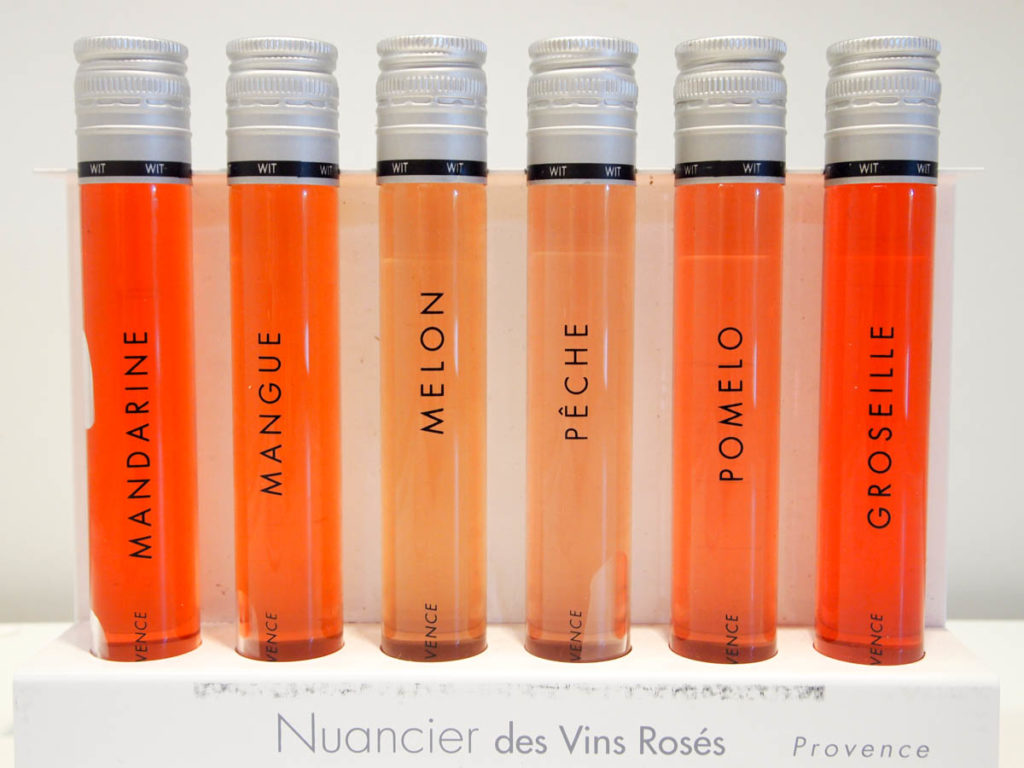
Unlike other regions where rosé is an afterthought or a why-not to the main act of white or red wines, in Provence it is the main act, with red wine being somewhat in the background. And since the Center for Rosé Research (Centre de Recherche et d'Expérimentation sur le Vin Rosé; https://www.centredurose.fr/) was established in Provence in 1999 - the world's only research institute dedicated to rosé wine - we can rest assured that Provencal rosé will continue to rule the roost there. They have even published the official colours of Provencal rosé, very useful for describing Provence AOP wines.

Today, nearly 90% of Provencal vines yield grapes intended for rosé. It's the traditional and preferred wine, enjoyed year-round and paired with many types of local foods... snails, rabbits, birds, lamb, fresh cheeses, herbs, fish, and more. The mouth-puckering acidity of Provencal rosés, pairs splendidly with cheeses like chèvre or Banon.

SOIL
Fast forwarding from the beginning of time to the Paleolithic era (Stone Age)... Provence went through significant climatic changes in the ~3.5 million year long Paleolithic era. Two ice ages and dramatic changes in sea level, for example. At the beginning of the Paleolithic era the sea level was nearly 500 ft (~150 m) higher than now, and by the end of the Paleolithic era it had dropped to nearly 500 ft (150 m) below the present sea level!

3.5 million years of the high sea level was a long time for much of present-day Provence  to remain submerged under water, but it allowed the formation of layered sedimentary rock like limestone, sandstone, and shale (which is primarily crushed clay and quartz), that happens to be favourable for grape vines. In the forensics world we often joke that sandstone wants to be a beach. I.e. where there is sandstone, there will be sand, and vice versa. So, in Provence, there are sandstone beds and sandy soils, and vines grow in both.

Limestone layers are formed by the deposits of marine mollusc skeletons which over time get compressed into rock. Incidentally, limestone is a soft rock and since it is layered, if in building construction, if limestone blocks are not oriented with the planar surfaces horizontal, layers can cleave off over time, leaving walls with a jagged surface. But in winemaking, it's the layered character of limestone that proves to be desirable because water collects between the planes and is available to the roots of grape vines without making them water-logged. Calcareous soils are basic (high pH) and facilitate cation exchange which is critical to nutrient uptake in grape vines (hence, the addition of lime as a soil conditioner for gardens!) and helps maintain acidity in the grapes late into the growing season. This ultimately results in wines with a higher acidity (lower pH), such as the delicious Chateau de Berne wines some of us #frenchwinophiles had this month!

Shale (aka mudstone) and sandstone are about the same but shale has unbound crushed particles and sandstone is rock. They are both mainly clay, silica, and quartz, and excellent media for grapevine growing. There are also areas with schist and granite in Provence.

WINES
Some of us #frenchwinophiles received three beautiful bottles of Provence rosé for our July event on French Rosés. The wines were from the Chateau de Berne group.

Fun Fact: As evidenced in the Chateau de Berne wines we've reviewed, Provençal rosé is often sold in creatively designed bottles of varying shapes. This - somewhat of a tradition now - is a strategy dating to the 1930s when wineries started bottling their own wines and needed a unique selling proposition (USP) to stand out amongst others.

2017 Ch. de Berne Emotion (https://provencerose.com/emotion-rose-wine)
50% grenache, 25% syrah, 25% cinsault
12.5% abv
SRP: $16 (sample)

Soil: limestone and clay soil, elevation 2,600 - 3,300 ft (800 - 1,000 m)

Colour: Light pink with gold edges, clear. Provence colour: pêche-melon.

Nose: A gorgeous, fragrant wine that we wanted to smell all day! Tart - citrus, and strawberries.

Taste: Delicious racy acidity with a long finish overall. Slight minerality with red summer berries and white flowers on the front. This is a lovely nuanced wine, would be perfect on its own too.

Pairing: We had this with classic tomato bruschetta and Délice du Poitou (Loire, France), a citrusy herbaceous two-month old goats milk cheese covered in vegetable ash. The rich velvety cheese was amazing with the acidity and aromatics of the wine.


2017 Ch. de Berne Inspiration (https://provencerose.com/inspiration-rose-wine
70% grenache, 20% cinsault, 10% syrah 

12.5% abv
SRP: $19.99  (sample)

Soil: limestone and clay soil, elevation 2,600 - 3,300 ft (800 - 1,000 m)

Colour: Light pink with gold edges, clear. Provence colour: light pêche.

Nose: Stony, stone fruit, strawberries

Taste: Juicy with a delicious racy acidity and a creamy mouthfeel. Cherries, strawberries, and white flowers on the front, with a medium finish. This is a lovely warm weather wine, not too complex.

Pairing: We had it with watermelon in pesto, a lavender chèvre with pistachios and crostini. Uh-mazing!

45% grenache, 35% cinsault, 15% syrah, 5% rolle (vermentino)
12.5% abv
SRP: $22  (sample)


Soil: The countryside vineyard is near an oak forest not too far from St. Tropez. The vines are grown in shale - a shallow bed of soil over a sandstone slab base.

Colour: Gorgeous rose gold and pink, clear. Provence colour: pêche-melon.

Nose: Fresh and floral, with strawberry, raspberry, and a slight peppery note

Taste: Juicy, well-structured, and delicious with crisp acidity but overall a warm, rounded flavour. Tart cherries, red berries, red currants, with a welcome minerality on the front and a bit of spice on the finish. This is an elegant wine and our favourite of the three!

Pairing: We had it with anchoïade and crudités, and the salty anchovies with the peppery radishes complemented the acidity of the wine very nicely.

___________________

Join the #frenchwinophiles on Twitter on Sat, 21 July 2018, 8 -10 AM PST to talk about  French Rosés and hear everyone's thoughts on it! And you can read more from the #frenchwinophiles here:
  • Michelle from Rockin’ Red Blog will be Celebrating the Provençal Lifestyle with Three Rosés.
  • Gwendolyn from Wine Predator prepares # RoséAllDay with Grilled Cheese Gourmet for #Winophiles.
  • Nicole from Somm’s Table adds Cooking to the Wine: Ultimate Provence Urban Rosé with Herbed Sous-Vide Chicken Breasts and Roasted Eggplant Sheet Pan.
  • David from Cooking Chat says it’s Always a Good Time to Sip Provence Rosé.
  • Jill from L’Occasion explains Why Rosé Matters, According to French Culture.
  • Martin from Enofylz Wine Blog discusses The Pleasures of Provençal Rosé #Winophiles.
  • Payal from Keep the Peas will share Rosé: The Original Red Wine.
  • Julia from JuliaConey.com talks about Rosé: Not from Provence but Just as Delicious!
  • Lauren at The Swirling Dervish, we’re Celebrating Our New Home with an Old Friend: Rosé from Provence.