Showing posts with label wine. Show all posts

Monday, September 9, 2019

INVITATION TO JOIN THE #WINOPHILES VIRTUAL TASTING OF CORSICAN WINES

Come and enjoy a taste of island life: no planes, trains, or automobiles needed!

https://demystifyingthevine.com/new-world-countries-2/old-world-western-europe/france/france-corsica/
In September, the French Winophiles blogging group is exploring wines from Corsica, France, a storied island known for many things including Napoleon Bonaparte, the second highest mountain in the Mediterranean, really stinky cheese, and increasingly excellent wine. Offer ends in September so join us now and come ready to tell us your experience and impressions on 21 September 2019, when we meet over a casual Twitter chat at 8 AM PST!

When we think of wine and Corsica together, the first thing that comes to mind is... well we don't really think of wine and Corsica together, do we?! But Corsica, in addition to being continuously occupied by humans since the Mesolithic era (a whopping 15,000 years BP (Before Present)), has also enjoyed the fruits of labour of it's various occupations by the Greeks, Italians, and now, French. Corsican wine has existed since ~570 BC when the Greeks introduced vitis vinifera and viticulture there, as they did everywhere else including France and Italy. Since then wine has been somewhat of a spotty pursuit in Corsica but it has been on a steady uptick thanks to its nine AOC regions, starting in 1968. We are, unfortunately, not doing samples this month so we will each rely on our local well-stocked wine shops to have a go at Corsican wine... and perhaps food too. We hope you'll join us!

How to join us: 

  • Send me email to tell me you’re in: Include your blog url, Twitter handle, and any other social media details. If you know your blog post title, include that although you can really just send it to me anytime on/before 17th September. We’d like to get a sense of who’s participating and give some shout-outs and links as we go. You can contact me at pvora19@gmail.com 
  • Find a Corsican wine and perhaps food, and prepare your blog post. But don’t post it yet!
  • Send your blog post title to me by Tuesday, 17th September to be included in the preview post. I will prepare a preview post with links to everyone's blogs shortly after I get titles. Your title should include “#Winophiles” or you can simply append the hashtag to the end of your title.
  • Publish your post between Friday 20th September and 8:00 a.m. EST on Saturday, 21st September. You can always schedule your post in advance if you have commitments that morning.
  • Include links to the other #Winophiles participants in your post, and a description of what the event is about. Before Friday I’ll provide the HTML code that you can add  to your initial post so that your post includes links to participating Winophiles. 
  • Once all the posts are live, I’ll send the updated HTML list so you can update the permanent links to everyone’s #Winophiles posts. 
  • Get social! After the posts go live, please visit your fellow bloggers posts’ to comment and share. We've also got a Facebook group for participating bloggers to connect and share. 
  • Sponsored posts are OK if clearly disclosed. Please be sure to disclose if your post is sponsored or if you are describing wine or other products for which you have received a free sample.

Thursday, October 18, 2018

LIRAC AOC: HIDDEN IN PLAIN SIGHT!


This month the French #winophiles explored Southern Rhône wines including some from Lirac AOC. A few of us, including I, received a generous four bottles of Lirac AOC wine from Teuwen Communications (http://teuwen.com/). Read to know more about the red Lirac wines I received!

Although the 1700-acred Lirac AOC in the Gard department of the Rhône Valley is literally across the street river from the very well-known Châteauneuf-du-Pape, it is most certainly not as well known as it should be. With a history of viticulture and winemaking dating to pre-Roman times, ongoing excellent wine making by a small group of small domains making large wines, a Mediterranean climate, a location more protected from the harsh Mistral winds than the Northern Rhône, and a slew of grape-friendly soils like galéts rouléts, limestone, sand, and red clay in various combinations, Lirac is poised to produce world-renowned excellent wines. Wines that should be as famous - if not more - as Ch.-du-Pape to the east. Instead, Lirac is full of "boutique" wineries that are family-owned and operated for generations, and many that are formally committed to Sustainable Farming practices.

Before Lirac was designated as a separate AOC in 1947, it was part of the Côtes du Rhône AOC, a designation that has existed since the mid-1700s, and at a time when Lirac was far more important a wine producing region than Ch.-du-Pape. Lirac AOC is spread over four communes, with  red, white, and rosé wines being produced. The wines here are similar to the Côtes du Rhône-Villages and Ch.-du-Pape wines. The main red grapes are grenache, syrah, mourvèdre, cinsault, red picpoul and clairette, and a few other varietals that complement the main three - GSM - grapes.

https://domainedarbousset.com/
A note on galéts rouléts: these rounded pebbles (called as such when they are within a specific size range, somewhere between boulders and various grades of sand) - are common in areas where rivers or oceans previously extended to present-day inland. The pebbles are formed by erosion from the force of the water, and are various types of rocks depending on the local geology: basaltic in Walla Walla, WA river channels, granitic in some parts of the Languedoc, and quartzite in Lirac and the rest of Southern Rhone. The pebbles, no matter what stone they are, are inert and offer no effect on the minerality or flavour of wine. But the fact that the pebbles retain heat from the daytime hours and keep the bases of the vines warm at night makes a difference to the ripening of the grapes and ultimately, the wine. They are a distinct part of climat.

The Lirac AOC wines and pairings we had...

FOOD
  1. Cheese and charcuterie plate, garnishes
  2. Icelandic lamb crusted with rosemary, lavender, thyme, savoury, marjoram, sage; Puy lentils
  3. Duck salmis (a very old-fashioned but outstanding way to cook duck), pommes fondantes, sautéed mushrooms, croutons
  4. Herb sausages, Puy lentils, pommes fondantes
  5. Duck rillettes, roasted grapes, fig jam, and gougères (with Comté and Füürtüfel cheeses)

2014 CH. DE MONTFAUCON "BARON LOUIS" LIRAC ROUGE, $24
http://www.chateaumontfaucon.com/en/index.html

Domain: From the famous Chateau de Montfaucon, as much a historic site with les ruines as a winery, with a long legacy dating to the 12th century and prehistoric times even before that! Owned and operated by Rodolphe de Pins, a UC Davis (CA) grad.


Grapes: 50% grenache, 15% syrah, 15% cinsault, 10% each mourvèdre and carignan. Destemmed and co-fermented for 7 days, then two weeks extended skin maceration. Aging: 70% of the blend aged in oak barrels, + 8 months bottle aging before release. 

Soil: sandy loam, limestone


Colour: Deep ruby, almost opaque


Nose: Berries, earth

Taste: Fresh berries, bramble, turned earth, hint of peppery spice. Silky tannins, medium+ acidity, lush, balanced with a long finish.

Pairing: 1: cheese and charcuterie plate. Absolutely perfect!


2015 DOMAINE D'ARBOUSSET LIRAC ROUGE, $15
https://domainedarbousset.com/

Domain: Gérald Lafont of Domaine D'Arbousset consults for 40 different wineries but Lirac is his passion. He farms sustainably on a 6.1 acre plot in Saint-Laurent-des-Arbres that he inherited from his father, and on another plot in the Claretière plateau in Lirac.


Grapes: 70% grenache, 10% each syrah, mourvèdre, cinsault, destemmed and fermented in concrete vats using indigenous yeasts. Aging: 70% in concrete, 30% in demi-muids, 18 months. 

Soil: galéts rouléts, sand, clay, limestone


Colour: Deep ruby, almost opaque


Nose: Berries, licorice, some earth

Taste: Raisins, red berries, pepper. Silky tannins, lush, balanced with a long finish. Very elegant wine.

Pairing: We had this with 2, 3, 5. This was one of our favourite wines of the four!


2015 DOMAINE MABY "BEL CANTO" LIRAC ROUGE, $20

Domain: The Maby family were originally shoemakers who, like the rest of the village, grew some grapes and made wine to sell locally. Now they have grown substantially in production and area, but are still very much a family-owned winery formally committed to Sustainable Farming practices.


Grapes: 100% grenache, whole cluster fermentation in 600 litre oak barrels (demi-muids) for 15 months


Soil: galéts rouléts, sand

Colour: Rich garnet, medium opacity


Nose: Red berries, peppery, floral, some earth

Taste: Cooked red berries, cherries, dried flowers, licorice. A lush wine with a peppery finish, medium-plus acidity, b
alanced tannins, and a medium-long finish. Delicious on its own or with food, even better after decanting for ~15 minutes.

Pairing: We had this with 2 and 3. While both pairings were delicious, the lamb was the star of the food pairings!


2013 DOMAINE DU CASTEL OUALOU CUVÉE FÛT DE CHÊNE ROUGE, $20

Domain: Terra Vitis certified family-owned and operated domain, since 1961.


Grapes: 
40% grenache, 50% syrah, 10% mourvèdre. Destemmed, foulage (grapes stomped with feet), fermented in steel tanks, and aged in concrete vats buried 17 ft. underground for 4 months then 225 litre oak barrels for 18 months.

Soil: clay, sand

Colour: Deep red, some purple, medium opacity


Nose: Red berries, vanilla, woody

Taste: Wood, pine needles, cocoa, peppery spice at the end. Medium acidity, balanced tannins, medium finish. A savoury and unique wine!


Pairing: 2, 3, 4. All delicious!


See the other rave reviews of  Southern Rhône wines from the rest of the #winophiles...

Friday, July 20, 2018

ROSÉ: THE ORIGINAL RED WINE

IN THE BEGINNING... 
...there was rosé. The first wine of France, the original French wine, made in the classic method of the Greeks, well before extended maceration and deep red wines. 

It's quite well known that the Romans, when they arrived in the 5th century BC, planted vines in present-day Provence, in fact, the name of the place itself is one given by the Romans. But the Greeks, having established themselves around Marseille in the 7th century BC, were there before, and they planted vines and brought wine making to the region, making wine their way, really the only way of the time, which was not too different from current rosé wine where the juice does not see prolonged contact with skins. The method of macerating red grapes and allowing extended contact of the juice with skins, the process which gives red wine its colour, was virtually unknown, certainly not common. So all wine from red grapes was rosé wine.

Rosé prevailed even after the Romans arrived and brought deep red wine and their wine making methods with them... back then, you did not want to be seen drinking a deep red wine which was considered brutish, the drink of drunkards and ignobles. So the typical way to drink wine was to mix it with water or, drink rosé.

Therefore, not only is Provence the oldest and first wine region in France, rosé is the first French wine and the original red wine!

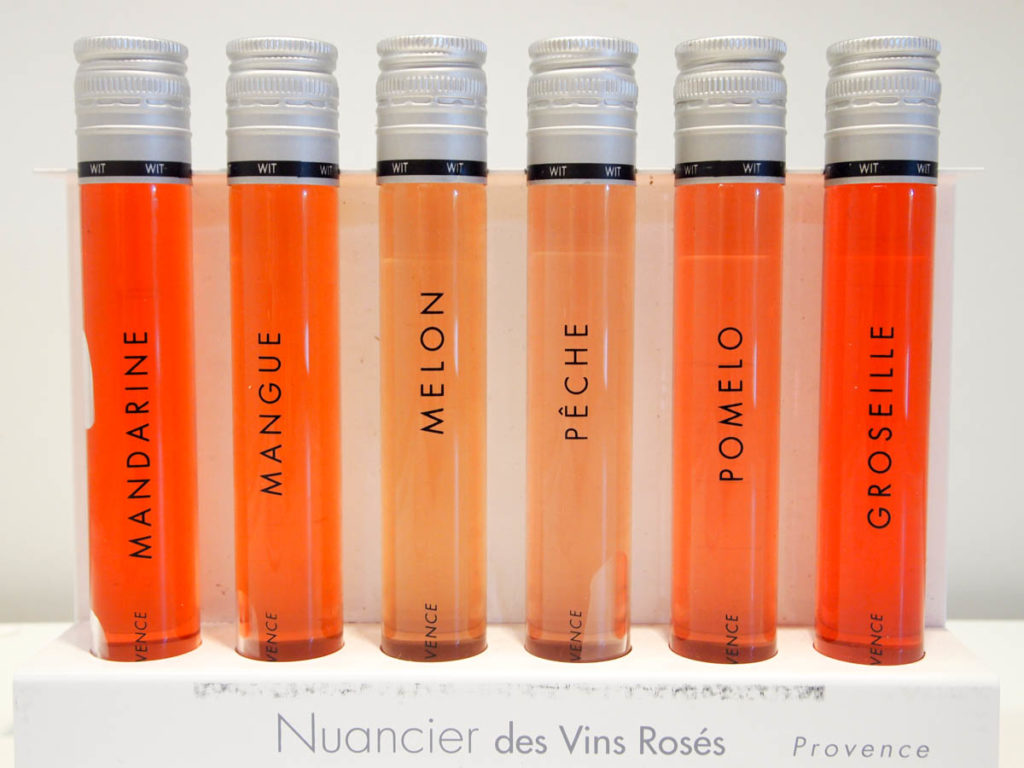
Image result for six colors of provence rose
Unlike other regions where rosé is an afterthought or a why-not to the main act of white or red wines, in Provence it is the main act, with red wine being somewhat in the background. And since the Center for Rosé Research (Centre de Recherche et d'Expérimentation sur le Vin Rosé; https://www.centredurose.fr/) was established in Provence in 1999 - the world's only research institute dedicated to rosé wine - we can rest assured that Provencal rosé will continue to rule the roost there. They have even published the official colours of Provencal rosé, very useful for describing Provence AOP wines.

Today, nearly 90% of Provencal vines yield grapes intended for rosé. It's the traditional and preferred wine, enjoyed year-round and paired with many types of local foods... snails, rabbits, birds, lamb, fresh cheeses, herbs, fish, and more. The mouth-puckering acidity of Provencal rosés, pairs splendidly with cheeses like chèvre or Banon.

SOIL
Fast forwarding from the beginning of time to the Paleolithic era (Stone Age)... Provence went through significant climatic changes in the ~3.5 million year long Paleolithic era. Two ice ages and dramatic changes in sea level, for example. At the beginning of the Paleolithic era the sea level was nearly 500 ft (~150 m) higher than now, and by the end of the Paleolithic era it had dropped to nearly 500 ft (150 m) below the present sea level!

3.5 million years of the high sea level was a long time for much of present-day Provence  to remain submerged under water, but it allowed the formation of layered sedimentary rock like limestone, sandstone, and shale (which is primarily crushed clay and quartz), that happens to be favourable for grape vines. In the forensics world we often joke that sandstone wants to be a beach. I.e. where there is sandstone, there will be sand, and vice versa. So, in Provence, there are sandstone beds and sandy soils, and vines grow in both.

Limestone layers are formed by the deposits of marine mollusc skeletons which over time get compressed into rock. Incidentally, limestone is a soft rock and since it is layered, if in building construction, if limestone blocks are not oriented with the planar surfaces horizontal, layers can cleave off over time, leaving walls with a jagged surface. But in winemaking, it's the layered character of limestone that proves to be desirable because water collects between the planes and is available to the roots of grape vines without making them water-logged. Calcareous soils are basic (high pH) and facilitate cation exchange which is critical to nutrient uptake in grape vines (hence, the addition of lime as a soil conditioner for gardens!) and helps maintain acidity in the grapes late into the growing season. This ultimately results in wines with a higher acidity (lower pH), such as the delicious Chateau de Berne wines some of us #frenchwinophiles had this month!

Shale (aka mudstone) and sandstone are about the same but shale has unbound crushed particles and sandstone is rock. They are both mainly clay, silica, and quartz, and excellent media for grapevine growing. There are also areas with schist and granite in Provence.

WINES
Some of us #frenchwinophiles received three beautiful bottles of Provence rosé for our July event on French Rosés. The wines were from the Chateau de Berne group.

Fun Fact: As evidenced in the Chateau de Berne wines we've reviewed, Provençal rosé is often sold in creatively designed bottles of varying shapes. This - somewhat of a tradition now - is a strategy dating to the 1930s when wineries started bottling their own wines and needed a unique selling proposition (USP) to stand out amongst others.

2017 Ch. de Berne Emotion (https://provencerose.com/emotion-rose-wine)
50% grenache, 25% syrah, 25% cinsault
12.5% abv
SRP: $16 (sample)

Soil: limestone and clay soil, elevation 2,600 - 3,300 ft (800 - 1,000 m)

Colour: Light pink with gold edges, clear. Provence colour: pêche-melon.

Nose: A gorgeous, fragrant wine that we wanted to smell all day! Tart - citrus, and strawberries.

Taste: Delicious racy acidity with a long finish overall. Slight minerality with red summer berries and white flowers on the front. This is a lovely nuanced wine, would be perfect on its own too.

Pairing: We had this with classic tomato bruschetta and Délice du Poitou (Loire, France), a citrusy herbaceous two-month old goats milk cheese covered in vegetable ash. The rich velvety cheese was amazing with the acidity and aromatics of the wine.


2017 Ch. de Berne Inspiration (https://provencerose.com/inspiration-rose-wine) 
70% grenache, 20% cinsault, 10% syrah 

12.5% abv
SRP: $19.99  (sample)

Soil: limestone and clay soil, elevation 2,600 - 3,300 ft (800 - 1,000 m)

Colour: Light pink with gold edges, clear. Provence colour: light pêche.

Nose: Stony, stone fruit, strawberries

Taste: Juicy with a delicious racy acidity and a creamy mouthfeel. Cherries, strawberries, and white flowers on the front, with a medium finish. This is a lovely warm weather wine, not too complex.

Pairing: We had it with watermelon in pesto, a lavender chèvre with pistachios and crostini. Uh-mazing!

45% grenache, 35% cinsault, 15% syrah, 5% rolle (vermentino)
12.5% abv
SRP: $22  (sample)


Soil: The countryside vineyard is near an oak forest not too far from St. Tropez. The vines are grown in shale - a shallow bed of soil over a sandstone slab base.

Colour: Gorgeous rose gold and pink, clear. Provence colour: pêche-melon.

Nose: Fresh and floral, with strawberry, raspberry, and a slight peppery note

Taste: Juicy, well-structured, and delicious with crisp acidity but overall a warm, rounded flavour. Tart cherries, red berries, red currants, with a welcome minerality on the front and a bit of spice on the finish. This is an elegant wine and our favourite of the three!

Pairing: We had it with anchoïade and crudités, and the salty anchovies with the peppery radishes complemented the acidity of the wine very nicely.

___________________

Join the #frenchwinophiles on Twitter on Sat, 21 July 2018, 8 -10 AM PST to talk about  French Rosés and hear everyone's thoughts on it! And you can read more from the #frenchwinophiles here:
  • Michelle from Rockin’ Red Blog will be Celebrating the Provençal Lifestyle with Three Rosés.
  • Gwendolyn from Wine Predator prepares # RoséAllDay with Grilled Cheese Gourmet for #Winophiles.
  • Nicole from Somm’s Table adds Cooking to the Wine: Ultimate Provence Urban Rosé with Herbed Sous-Vide Chicken Breasts and Roasted Eggplant Sheet Pan.
  • David from Cooking Chat says it’s Always a Good Time to Sip Provence Rosé.
  • Jill from L’Occasion explains Why Rosé Matters, According to French Culture.
  • Martin from Enofylz Wine Blog discusses The Pleasures of Provençal Rosé #Winophiles.
  • Payal from Keep the Peas will share Rosé: The Original Red Wine.
  • Julia from JuliaConey.com talks about Rosé: Not from Provence but Just as Delicious!
  • Lauren at The Swirling Dervish, we’re Celebrating Our New Home with an Old Friend: Rosé from Provence.

Saturday, June 16, 2018

ALSACE: A GEOLOGIST'S DREAM

This month at the #frenchwinophiles we've been all about Alsace! Another cool weather wine region in France, this time in the NE. Alsace, as we know, is in the rain shadow of the ancient Vosges mountains in NE France at the border of Germany. So on the border in fact, that it's been back and forth between Germany and France numerous times although these days Alsace is in France. I received four splendid samples of Alsace wines from the generous folks at Alsace Rocks and I've reviewed three here, the last one to come shortly.


When thinking of Alsatian wine few, if any, of us might immediately think of the paleozoic evolution of the Vosges mountains or the fact that the Rhine Valley, home to a majority of Alsace wines, was the site of Central Europe's most significant seismological event, the Basel earthquake in 1356. In fact, the Rhine Valley, so favourable to grapevine growing, is a rift valley, a zone where the the lithosphere is being pulled apart, much like pull apart bread where if you pull one section off, an adjacent piece might start to cleave off as well.  In other words, it's on a geological fault. Needless to say, the earth in Alsace has been very active for not just centuries, but millennia, and continues to be so. The granitic Vosges mountains are over 570 million years old but after their formation and well before the Rhine Valley formed, the Vosges were below sea level, and subjected to layers of sedimentitious deposits... sandstone - which is essentially pressed sand - at the bottom, limestone - which is essentially decomposed seashells next, and marl - calcium carbonate-rich clay, also sometimes called mudstone at the top.

It's safe to say that the soil in the majority of the Rhine Valley is a marble cake of calcium carbonate-based soils from various geologic eras, along with granite on the hillsides of the Vosges and volcanic soil on the other side, a remnant from the now extinct Kaiserstuhl which is no longer useful as a volcano but is home to the largest wine cellars in Western Europe.

What does all this mean vis-à-vis Alsace wine? In a nutshell, this:
  • Sandstone: elegant restrained aromatic wines, pale color
  • Limestone: sprightly fresh acidity and citrus-y juiciness to the wine
  • Marl: complex wines with well defined structure
  • Granite: lower acidity, balanced wine
  • Volcanic: aromatic wine with discernible minerality on the nose and palate

Beyond vine growing and other agriculture, geology matters in daily life. The next time you look at an old building think about what the stone is, and whether it came from a place that was below sea level at some point long ago, or from rock formed from the folding of layers of the earth, or from rock formed from soil being trapped and heated to intensely high temperatures. In forensics, we use all these clues and more to piece together the puzzle when solving problems. Geology is everywhere, and Alsace offers an entire course on it in one area!

2013 GEWÜRZTRAMINER TRADITION
DOMAINE PFISTER, http://www.domaine-pfister.com/

Domaine Pfister is a family owned and operated winemaker, seven generations strong, growing a select variety of grapes on their primarily argilo-calcareous (clay/sand-limestone) soils. The resulting wines, no matter the grape, have the bright acidity imparted by limestone (calcareous) soils and the richness and depth from the clay. And since Alsace is already a cool climate, and clayey limestone soils are cooler soils, the wine also has a delightful astringency without being overbearing.

The grapes are grown in limestone soil, and the wine has 13.5% ABV. The bouquet is fairly straightforward, not too complex, with overripe stone fruit and an undeniable whiff of petrol, but not in a bad way. On the palate it is elegant, off-dry with a medium finish, minerality, and notes of dried roses, stone fruit, and citrus.


This gewürztraminer is discernibly different from German gewürztraminers since it's drier and less sweet. We wouldn't mind a bit higher acidity, but it's excellent nevertheless with the classic pairing of muenster and petit muenster cheeses. + grapes, and dried apricots and cranberries.

We also had it with spiced elk, lemony hummus, pickled onions, peppers and cucumbers, and olives... outstanding with the wine! We also enjoyed it on its own, and at $30 it won't break the bank if you want to give it a go. You won't regret it!


2015 RIESLING "CUVÉE CHARLES"
CHARLES BAUR, http://www.vinscharlesbaur.fr/en/

The Baur family has owned the Charles Baur estate in the heart of Alsace since the early 18th century. The Riesling we sampled is fermented with indigenous yeasts and aged on the lees for several months. It is a 13% ABV wine, grown in sandy gravel soil. The wine is a beautiful pale yellow, clear with a bouquet and tasting notes mainly of citrus, citrus zest, and white flowers. It's sprightly and balanced with a medium-long finish. Not too complex a wine but still superb.


We had it with coq au riesling (chicken in riesling sauce, made with this same wine) and buttered spätzle. Perfect for a leisurely weekend dinner! At $23, this bottle is a must-buy for warm days!


2015 PINOT BLANC
CAVE DE RIBEAUVILLÉ, http://www.vins-ribeauville.com/en/

Cave de Ribeauvillé has been around since 1885, making it the oldest wine co-op (cave, kaav, is co-op in French) in France. 38 members only, and the co-op buys the entire harvest from each member, so everyone has a vested interest in the wine that comes from the co-op. This particular wine is from grapes grown on a 22.5 acre vineyard near Ribeauvillé. Jean Baltenweck, the vineyard owner, cultivates the grapes on limestone soil using organic agriculture methods with no chemical treatments, and low yields. At 12.5% ABV, this organic 2015 Pinot Blanc is a refreshing but intense wine, perfect for a warm day and a light lunch. A clear wine with a greenish-gold hue, and a gorgeous, primarily grapefruit-citrus zest bouquet with some dried stone fruit. On the palate, it's dry, not very complex or lingering, but has a mouthwatering acidity, is crisp, fresh, and pleasantly lemony. We relished it with galettes de sarrasin complète (Brittany-style buckwheat crepes, eggs, comté cheese, sautéed mushrooms) and butter lettuce with a lemon vinaigrette. Good now or within the next 3 years. Priced at <$20 a bottle this is even more 
of a winner!

All the wines we received were terrific, and we'd most certainly buy more bottles of each for the summer. Perfect to bring to a party as well!

See how the other #winophiles are enjoying Alsace and what they're saying about it: