Showing posts with label wine tasting. Show all posts

Friday, May 15, 2020

WELCOMING SUMMER WITH A BERRY DELICIOUS BROUILLY


This May the French Winophiles are exploring Cru du Beaujolais. All 10 crus, so lots of options and lots to look forward to. The Beaujolias crus are stacked between Burgundy (north) and Rhône (south) and offer an exhilarating variety of wines to try, warranting a tasting dedicated solely to Beaujolais!

               Image from https://www.discoverbeaujolais.com/

Cindy from Grape Experiences is our host this month, read her preview post here to find out more about the finer points of Cru Beaujolais.

CRU BEAUJOLAIS: BROUILLY
I had originally thought of doing a north-to-south tasting of all 5 Cru Beaujolais wines we've got in the cellar, which would've been a great way to really highlight the nuances of each cru. But I've put a weekly limit to the number of alcoholic drinks we're allowed, and the virtual socialising has been adding up so there's no way we could've done the full tasting *and* the social hours and stayed within our limit. The upside to all the socialising I suppose, is that no one is taking their relationships for granted and everyone is going out of their way to keep in touch, including us, even if it is just a check-in to say hello. Everything is virtual nowadays, even meditation sessions! Although, I chicken out of those every week - I have done yoga and meditation since a young age, but I just cannot truly meditate in front of a screen.

So I settled on a Brouilly for our May 2020 #winophiles tasting. Brouilly is the southernmost of Beaujolais crus, and at 1,315 hectares, is also the largest, with ~20% of the total Cru Beaujolais area. The wines are fresh, fruity, can be enjoyed young or aged up to 10 years, and are easy to pair with  various savoury foods. And, as is the case with all of Beaujolais, a great value for $$$. The only red grape allowed in Brouilly is Gamay, with Chardonnay, Melon de Bourgogne, and Aligoté allowed up to 15% in a blend. The four different types of soils on and around Mount Brouilly allow nuanced wines that can fit every palate. There is a long history of superior wine making and as far back as 1769, Brouilly was producing elegant wines that were authorised to be sold to Paris. Certainly a feather in the cap at that time.

I was introduced to Beaujolais and its wine-making communes when I took a wine class during my undergraduate years at Purdue Univ. In the early 2000s IN did not have much going on by way of wine but the class was incredible. The professor had been a wine consultant with American Airlines for decades prior so we always had the best wines in class and reps from all over who came to lecture, including Dom Perignon and other premium champagne houses. And every class included food pairings with the wines - looking back, I'm amazed and impressed at the effort and enthusiasm Prof. Vine put into the class.

THE WINE
2017 Les Frères Perroud "Amethyste", 13% ABV
SRP $16

The Perroud brothers grow the grapes for the Amethyste wine on the southern slope of the Saburins hill in Quincié village, one of the six villages of the Brouilly AOC. The wine is named as such because of the crystalline amethyst layer deep in the soil.

The wine is 100% Gamay and is aged for one year in Burgundian neutral oak barrels. According to the winery website, this wine is best between 2018 and 2032, so we definitely had it on the young side of that time period. Nevertheless, it is a beautiful ruby coloured wine, with aromas full of berries black and blue, ripe purple plums, cooked ripe raspberries, and a hint of black pepper in the very back. Same on the palate, with plush tannins and juicy acidity. The finish is medium and overall the wine is balanced although a bit simple. A splendid wine that I'd love to try again in a few years to see if anything has changed.

We enjoyed it with a classic Beaujolais pairing of charcuterie, cheeses, a goat cheese and leek crumble, and sardine butter. All the food was an expectedly incredible complement to the wine. Even the sardine butter which is silky and more buttery than briny or fishy. We actually had Coravined two glasses to start, but the food and wine were so delicious together that we ended up opening the bottle.

See the links below to find out what my fellow #winophiles are saying about the Cru Beaujolais wines they chose and the superb food pairing ideas for each wine! Join our Twitter chat on Saturday May 16 from 8 - 9 AM PST at #Winophiles. Hope to see you there!
  • Wendy from A Day in the Life on the Farm had “A Casual COVID19 Visit with Charcuterie and Chateau de Poncie Le Pre Roi Fleurie”
  • Camilla from Culinary Adventures with Cam pairs “Tuna Pâté + Joseph Drouhin Hospices De Belleville Brouilly 2016”
  • Jill at l’Occasion explores “Soil + Wind: Tasting Cru Beaujolais with Château du Moulin-à-Vent”
  • Payal of Keep the Peas is “Welcoming Summer with a Berry Delicious Brouilly”
  • Lynn at Savor the Harvest finds “Fleurie – The Princess Queen of Beaujolais Crus #Winophiles”
  • Jane at Always Ravenous explores “Cru Beaujolais: Tasting and Food Pairings”
  • Jeff at Food Wine Click enjoys “Cru Beaujolais at the Grill”
  • Robin at Crushed Grape Chronicles shares “Flowers for Julien – Beaujolais in May”
  • Linda at My Full Wine Glass discovers “Gamay and Granite – A Beaujolais Love Story #Winophiles”
  • Susannah Gold at Avvinare finds “Cru Beaujolais – An Endless Discovery”
  • Pinny at Chinese Food and Wine Pairing discovers “Cru Beaujolais – Cedric Lathuiliere Fleurie Paired with Frog Legs #Winophiles”
  • Nicole at Somms Table explains “Julien Sunier Régnié and a Focaccia Fail”
  • Lauren at The Swirling Dervish meets “Morgon de Jean-Pau Thévenet, One of the Beaujolais Gang of Four”
  • Kat at The Corkscrew Concierge is “Exploring the Differences & Pairing Versatility of Cru Beaujolais”
  • Martin at Enofylz Wine Blog considers “A Taste of Chénas, Beaujolais’ Rarest Cru”
  • Gwendolyn at Wine Predator shares “Comparing Louis Tete’s 2016 Brouilly and Morgan Gamay from Beaujolais With Pairings”
  • Terri at Our Good Life shares “Cru Beaujolais with Rustic Foods”
  • Cindy at Grape Experiences, is loving “The Wines of Fleurie – An Enchanting Introduction to Cru Beaujolais”

Saturday, September 15, 2018

WHITE WINE, RED WINE, BLACK WINE, CAHORS!

The title is a riff on the old nursery rhyme Round and Round the Garden which ends with "One step, two step, three step, bear!". Definitely unrelated to Cahors or any other wine, really. But it was on my mind and so here we are.

"France vs. Argentina" is what this blog post *should* be titled because that's the gist of malbec.

As usual, we can thank the Romans for planting grape vines literally everywhere in the Middle Ages including present day southwest France. Malbec, the intense grape that yields wine so opaque that it has earned the nickname of Black Wine, was prolific in the area around the river Lot, that is now Cahors. But because of shipping regulations that favoured Bordeaux wines, malbec never enjoyed the fame and glory that Bordeaux did even back then. The phylloxera blight in the late 19th century that wiped out nearly all of the Cahors malbec vines certainly did not help things.

While Cahors - and much of France - was dealing with that, malbec vines brought to Argentina in the mid-1800s, were thriving. And have continued to thrive to the extent that for wine, Argentina has become synonymous  with malbec, and French malbec isn't at the forefront of most malbec enthusiasts. But that is changing as more and more vintners are making wine in Cahors and making excellent cool climate malbec from grapes grown in limestone soil, quite different from the fruity ripe malbecs from Argentina.

It can take years to find limestone soil in Argentina, but it takes a few minutes in Cahors. Especially around the terraces above the river Lot, which have a thin gravel and topsoil layer with solid limestone underneath. This soil combined with the cooler climate of Cahors results in tannic wine with a delicious savoury streak. Wine that's distinctly different from the Argentine malbecs which are more supple, fruit-forward, and overall less nuanced than Cahors malbecs. 

This month with the French #winophiles we were tasting Cahors wines, and we had...

2015 CHATEAU LAGRÉZETTE SEIGNEUR DE GRÉZETTE
87% malbec, 13% merlot

Soil: limestone base, gravel topsoil, second terrace above the river Lot

Colour: Deep purple, almost opaque
Nose: Savoury, peppery, some violet, earth

Taste: Smoky, blackerries, pepper, graphite, and leather. Balanced tannins, very delicious everyday wine!

Pairing: We had this with fromage fort and figs. The fromage fort had a mix of several cheeses including blue cheese and quark. It made an excellent match for the savoury wine!

Price: $13


85% malbec, balance merlot and tannat

Soil: limestone base, gravel topsoil, second and third terraces above the river Lot

Colour: Deep purple, almost opaque
Nose: Blackberries, some violet, earth

Taste: Blackberries, pepper, and dusty tannins. Overall more fruit forward and jammy than the Lagrézette, which we preferred over this wine.

Pairing: We had this with broiled bread, fromage fort and green olive tapenade. Terrific match for this wine!

Price: $12


See what the rest of the #winophiles are saying about Cahors..

Friday, July 20, 2018

ROSÉ: THE ORIGINAL RED WINE

IN THE BEGINNING... 
...there was rosé. The first wine of France, the original French wine, made in the classic method of the Greeks, well before extended maceration and deep red wines. 

It's quite well known that the Romans, when they arrived in the 5th century BC, planted vines in present-day Provence, in fact, the name of the place itself is one given by the Romans. But the Greeks, having established themselves around Marseille in the 7th century BC, were there before, and they planted vines and brought wine making to the region, making wine their way, really the only way of the time, which was not too different from current rosé wine where the juice does not see prolonged contact with skins. The method of macerating red grapes and allowing extended contact of the juice with skins, the process which gives red wine its colour, was virtually unknown, certainly not common. So all wine from red grapes was rosé wine.

Rosé prevailed even after the Romans arrived and brought deep red wine and their wine making methods with them... back then, you did not want to be seen drinking a deep red wine which was considered brutish, the drink of drunkards and ignobles. So the typical way to drink wine was to mix it with water or, drink rosé.

Therefore, not only is Provence the oldest and first wine region in France, rosé is the first French wine and the original red wine!

Image result for six colors of provence rose
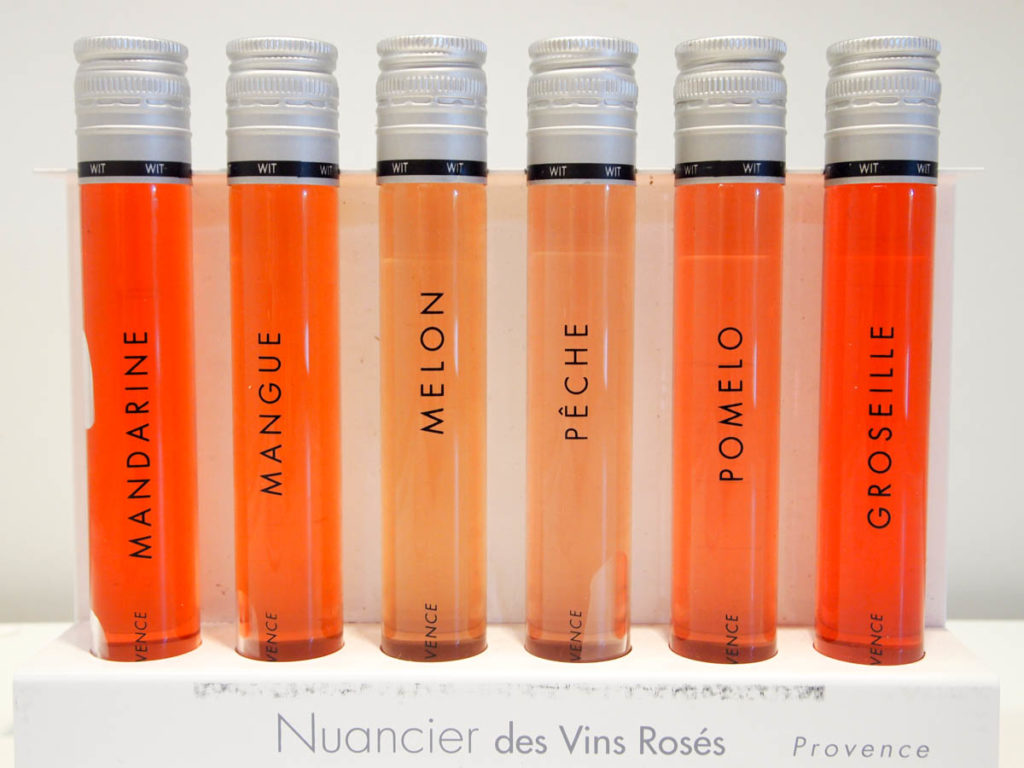
Unlike other regions where rosé is an afterthought or a why-not to the main act of white or red wines, in Provence it is the main act, with red wine being somewhat in the background. And since the Center for Rosé Research (Centre de Recherche et d'Expérimentation sur le Vin Rosé; https://www.centredurose.fr/) was established in Provence in 1999 - the world's only research institute dedicated to rosé wine - we can rest assured that Provencal rosé will continue to rule the roost there. They have even published the official colours of Provencal rosé, very useful for describing Provence AOP wines.

Today, nearly 90% of Provencal vines yield grapes intended for rosé. It's the traditional and preferred wine, enjoyed year-round and paired with many types of local foods... snails, rabbits, birds, lamb, fresh cheeses, herbs, fish, and more. The mouth-puckering acidity of Provencal rosés, pairs splendidly with cheeses like chèvre or Banon.

SOIL
Fast forwarding from the beginning of time to the Paleolithic era (Stone Age)... Provence went through significant climatic changes in the ~3.5 million year long Paleolithic era. Two ice ages and dramatic changes in sea level, for example. At the beginning of the Paleolithic era the sea level was nearly 500 ft (~150 m) higher than now, and by the end of the Paleolithic era it had dropped to nearly 500 ft (150 m) below the present sea level!

3.5 million years of the high sea level was a long time for much of present-day Provence  to remain submerged under water, but it allowed the formation of layered sedimentary rock like limestone, sandstone, and shale (which is primarily crushed clay and quartz), that happens to be favourable for grape vines. In the forensics world we often joke that sandstone wants to be a beach. I.e. where there is sandstone, there will be sand, and vice versa. So, in Provence, there are sandstone beds and sandy soils, and vines grow in both.

Limestone layers are formed by the deposits of marine mollusc skeletons which over time get compressed into rock. Incidentally, limestone is a soft rock and since it is layered, if in building construction, if limestone blocks are not oriented with the planar surfaces horizontal, layers can cleave off over time, leaving walls with a jagged surface. But in winemaking, it's the layered character of limestone that proves to be desirable because water collects between the planes and is available to the roots of grape vines without making them water-logged. Calcareous soils are basic (high pH) and facilitate cation exchange which is critical to nutrient uptake in grape vines (hence, the addition of lime as a soil conditioner for gardens!) and helps maintain acidity in the grapes late into the growing season. This ultimately results in wines with a higher acidity (lower pH), such as the delicious Chateau de Berne wines some of us #frenchwinophiles had this month!

Shale (aka mudstone) and sandstone are about the same but shale has unbound crushed particles and sandstone is rock. They are both mainly clay, silica, and quartz, and excellent media for grapevine growing. There are also areas with schist and granite in Provence.

WINES
Some of us #frenchwinophiles received three beautiful bottles of Provence rosé for our July event on French Rosés. The wines were from the Chateau de Berne group.

Fun Fact: As evidenced in the Chateau de Berne wines we've reviewed, Provençal rosé is often sold in creatively designed bottles of varying shapes. This - somewhat of a tradition now - is a strategy dating to the 1930s when wineries started bottling their own wines and needed a unique selling proposition (USP) to stand out amongst others.

2017 Ch. de Berne Emotion (https://provencerose.com/emotion-rose-wine)
50% grenache, 25% syrah, 25% cinsault
12.5% abv
SRP: $16 (sample)

Soil: limestone and clay soil, elevation 2,600 - 3,300 ft (800 - 1,000 m)

Colour: Light pink with gold edges, clear. Provence colour: pêche-melon.

Nose: A gorgeous, fragrant wine that we wanted to smell all day! Tart - citrus, and strawberries.

Taste: Delicious racy acidity with a long finish overall. Slight minerality with red summer berries and white flowers on the front. This is a lovely nuanced wine, would be perfect on its own too.

Pairing: We had this with classic tomato bruschetta and Délice du Poitou (Loire, France), a citrusy herbaceous two-month old goats milk cheese covered in vegetable ash. The rich velvety cheese was amazing with the acidity and aromatics of the wine.


2017 Ch. de Berne Inspiration (https://provencerose.com/inspiration-rose-wine
70% grenache, 20% cinsault, 10% syrah 

12.5% abv
SRP: $19.99  (sample)

Soil: limestone and clay soil, elevation 2,600 - 3,300 ft (800 - 1,000 m)

Colour: Light pink with gold edges, clear. Provence colour: light pêche.

Nose: Stony, stone fruit, strawberries

Taste: Juicy with a delicious racy acidity and a creamy mouthfeel. Cherries, strawberries, and white flowers on the front, with a medium finish. This is a lovely warm weather wine, not too complex.

Pairing: We had it with watermelon in pesto, a lavender chèvre with pistachios and crostini. Uh-mazing!

45% grenache, 35% cinsault, 15% syrah, 5% rolle (vermentino)
12.5% abv
SRP: $22  (sample)


Soil: The countryside vineyard is near an oak forest not too far from St. Tropez. The vines are grown in shale - a shallow bed of soil over a sandstone slab base.

Colour: Gorgeous rose gold and pink, clear. Provence colour: pêche-melon.

Nose: Fresh and floral, with strawberry, raspberry, and a slight peppery note

Taste: Juicy, well-structured, and delicious with crisp acidity but overall a warm, rounded flavour. Tart cherries, red berries, red currants, with a welcome minerality on the front and a bit of spice on the finish. This is an elegant wine and our favourite of the three!

Pairing: We had it with anchoïade and crudités, and the salty anchovies with the peppery radishes complemented the acidity of the wine very nicely.

___________________

Join the #frenchwinophiles on Twitter on Sat, 21 July 2018, 8 -10 AM PST to talk about  French Rosés and hear everyone's thoughts on it! And you can read more from the #frenchwinophiles here:
  • Michelle from Rockin’ Red Blog will be Celebrating the Provençal Lifestyle with Three Rosés.
  • Gwendolyn from Wine Predator prepares # RoséAllDay with Grilled Cheese Gourmet for #Winophiles.
  • Nicole from Somm’s Table adds Cooking to the Wine: Ultimate Provence Urban Rosé with Herbed Sous-Vide Chicken Breasts and Roasted Eggplant Sheet Pan.
  • David from Cooking Chat says it’s Always a Good Time to Sip Provence Rosé.
  • Jill from L’Occasion explains Why Rosé Matters, According to French Culture.
  • Martin from Enofylz Wine Blog discusses The Pleasures of Provençal Rosé #Winophiles.
  • Payal from Keep the Peas will share Rosé: The Original Red Wine.
  • Julia from JuliaConey.com talks about Rosé: Not from Provence but Just as Delicious!
  • Lauren at The Swirling Dervish, we’re Celebrating Our New Home with an Old Friend: Rosé from Provence.