Showing posts with label winophiles. Show all posts

Thursday, August 19, 2021

JURA FTW - FOR THE #WINOPHILES - IN AUGUST!


A sliver between Burgundy, France and Switzerland, Jura might be one of the smallest wine regions in France but it is not one to be sidelined. For one, Louis Pasteur, the chemist and biologist indelibly etched in the history of modern humanity was born and raised in the Jura region - and even owned a vineyard near Arbois! But apart from that, Jura boasts a variety of grapes and wines made from those grapes.

Vin Jaune - the sherry-adjacent yellow wine - might be ubiquitous to Jura and it is delicious no doubt but there's much more to explore! Red, white, yellow, crémant... with wine made from grapes including Savagnin, Poulsard, Trousseau, Chardonnay, and Pinot Noir, there is a wine for all tastes. And there's also the wine-adjacent Macvin du Jura, a vin de liqueur made from grape juice+must, boiled, and fortified with marc, a type of brandy.'

So join us #winophiles this August as we delve into Jura wine of all manner. I can't wait to find out what everyone's sipping, savouring, and sharing with us this month! Get the inside scoop on Twitter, 8 AM PST on 21 August at #winophiles. A bit of a preview:

Tuesday, May 21, 2019

AUDE: ALIVE IN MORE WAYS THAN WINE


This month in May the #winophiles focussed on Languedoc-Roussillon in southern France, hosted by LM Archer. A lucky few of us received samples from Gérard Bertrand, who makes biodynamic wines at his Demeter certified winery in the Aude department of Occitanie in Languedoc-Roussillon.

The present-day region of Aude has done a lot: been inhabited since 1,500,000 BC, site of Europe's oldest human skull, lived through the usual European tumult of the Greeks, Romans, even Arabs for a while, but also benefitted from the "civilisation" part of each of these groups who brought viticulture, agriculture, cuisine, art, architecture, and cultural diversity.

The Greeks planted the first vines in Aude in the 1st century, but the industry really only caught on in the early 19th century. Around the same time as the French architect and theorist Viollet-le-Duc (1814-1879), who was not a formally trained architect but spent more than half of his career restoring Gothic-era castles, cathedrals, and public buildings, including the Notre Dame de Paris and the city walls of Carcassonne in the Aude. He is considered one of the first theorists of current architecture and historic preservation practices, a proponent of using restoration materials that inform the function of the structure rather than simply duplicating what was there. His theories of honest structural integrity and creative interpretation over exact replication made him a controversial figure and he continues to be so, hotly debated by all of us in historic preservation and engineering. When designing replacements for the statues at the top of the Notre Dame de Paris, he precociously designed Saint Thomas to resemble himself. The statue is there for all to see!


A third of the land in Aude is now planted with grape vines, although Aude/Languedoc-Roussillon might not be the first wine region you think of in France. But vintners like Gérard Bertrand are bringing more of a sense of place to the wines there, and making creative wines "of the land" through biodynamic practices rather than recreating what was already being made there. Much like V.-l.-Duc's writings and practices that inform but aren't the same as our evolving approaches to restoration and theories of historic preservation. E.g. in the reconstruction of the Notre Dame de Paris roof that will never be rebuilt to what was there when it burnt - which was already not original - but rather it will be rebuilt to remind us of what was there while also being foremost a roof. Considering how much Aude has lived from prehistoric man to V.-l.-Duc and forward thinkers like Gérard Bertrand and his biodynamic ways in the single largest wine growing region in the world, we can agree that Aude and Languedoc-Roussillon continue to be alive in more ways than wine!

2018 GÉRARD BERTRAND "CIGALUS" BLANC

According to the GB website, "Cigalus enjoys a hot, sunny Mediterranean climate (described as “semi-arid with temperate spring variants”) ensuring early ripening of all the grape varieties. This arid climate (low rainfall) is offset by the very deep soils (sediments deposited by the Aussou, a stream at the edge of the estate) which store the winter rains for longer but which are less fertile due to the presence of a slightly chalky sandstone in the subsoil, dating back to the Campanian (secondary era, prior to the emergence of the Pyrenees). LABEL DEMETER"

WINE: The wine, a blend of chardonnay, sauvignon blanc, and viognier, is a beautiful pale gold colour with lightly viscous tears, aromas of ripe citrus, citrus peel, white stone fruit, toast, honey on the nose. On the palate the wine is supple and silky with an unctuous mouthfeel and notes of butter in addition to the same aromas as on the nose. See the Tech Sheet for the winery's biodynamic approach to this wine, and other information.

PAIRING: We paired the wine with acciughe al verde, or anchovies in green sauce. The salty anchovies and the herbal sauce are a match made in heaven for a wine like the Cigalus Blanc. The acidity of the wine walks with the brininess of the anchovies and the oak aging helps tone down each bite while the citrus enhances the light fruity olive oil and the salty fish. Fun Fact: This classic Piemontese snack is a hark back to the days when salt was smuggled through France and Italy in creative ways including by hiding in layers of anchovies under the pretext of preserving them. The heavily salted anchovies that we desalinate before using today, were a way to smuggle salt in to Italy where it was in demand amongst the rich. Salt was the truffle of the 18th/19th century! 

We also had a delightful tuna ceviche which went splendidly with the wine. The occasional heat of the green chiles de arbol in the ceviche was a nice surprise soothed by bits of avocado. Fun FactChiles de arbol are commonly used dried in Mexican cookery but in regional Indian cuisine they are used in all their green splendor in all manner of ways including just biting into them with a meal. It's hard to believe that chiles came to India relatively recently, through the Portuguese via Spain via Mexico where they are native. Potatoes and tomatoes are equally foreign ingredients that are now well integrated into all types of Indian cuisine.

Check out the other #winophiles thoughts on Languedoc-Roussillon wines!

Saturday, April 20, 2019

CHABLIS: A TALE OF TWO SOILS


If Eminem were rapping about white wine, he might have said: 

May I have your attention, please?
May I have your attention, please? 
Will the real Chablis please stand up? 

Chablis... so much to be said about it and evocative of so many personal meanings and  memories. Including perhaps utter shock at the discovery that Chablis is just... chardonnay!  A grape originally from Burgundy, France. Chances are, that if you were drinking "chablis" through the early 2000s, etc. it was literally any white wine that someone wanted to call chablis because it sounds more legitimate than calling it White Wine. It did not *have* to be Chablis from the Chablis AOC in Burgundy - you know, the real Chablis - or even Chardonnay, which no one seemed to think was an important distinction. All this because after reeling in the aftermath of WWs I and II, powdery mildew and phylloxera, Chablis faded into the background for a long time. The vineyards eventually made somewhat of a successful comeback but the casual misuse of "Chablis" continued unchecked around the world. In 2006 luckily, things were cleaned up and a regulation was passed that restricted the name Chablis to wine produced in the Chablis AOC in Burgundy, France, a stone's throw from the charming village of Chablis, and where chardonnay is the only grape used to make Chablis. That's the Chablis we're exploring with The French #winophiles this month (April).

Source: National Academies of Sciences, 
Engineering, Medicine
Now that we know, let's get into it... a nerdy topic very dear to me: masonry, stone, and all things related. Such as geology, which really is just a time-lapse of the life-cycle of stone. It tells the story of how each type of stone, soil, mass of mineral dust was born, how it lived, and how it has continued to shape-shift its way through millions of years. It tells the story of the carbon cycle. Ashes to ashes, dust to dust.

TERROIR
Terrior - climate and soil - informs the flavour of all edible things including coffee, cacao, and wine. Non-aromatic grapes like chardonnay which aren't loaded with beautiful fruit and floral notes especially rely on terroir and vinification for the final outcome, i.e. what you smell and taste in the wine. Chardonnay is native to Burgundy and, dare I say, the best expression of the grape comes from wine made there. Especially in Chablis, a northerly cold region of Burgundy where the ancient seabed has formed two distinct sedimentary soil types: Kimmeridgian (clay + limestone) and Portlandian (weathered limestone). Both named after stages of the Jurassic epoch and both formed from heated and compressed remnants of ancient molluscs and shellfish. 

Portlandian, Kimmeridgian, Portland stone, Portland cement, limestone, ancient Roman tabby concrete - all same but different, all requiring thermal decomposition of molluscs. Created by heating (burning) shellfish shells, mixing with  more shells, sand, and water, poured into moulds if you're making something like a wall, or left free-form in nature. A basin of limestone marl starts near the Isle of Portland, Dorset in England (where Portland stone originates and where Portland cement was invented), and runs all the way down through Champagne, the Loire Valley, and Burgundy.

Tabby Walls at Ft. Livingston, LA (Source: P. Vora, personal collection)
(Fun Fact: to see Portland stone, visit the UN headquarters in NYC or Buckingham Palace, London. To see dramatic shell-studded tabby walls, see the photo to the left or snag a visit to Ft. Livingston, Grand Terre Island, LA - I worked on that partially submerged structure after the BP oil spill in 2010 and it remains my most challenging and fascinating project.)

Grapevines love limestone soil - it offers an abundant source of plant-accessible calcium carbonate, greater nutrient uptake by the vines, excellent water retention and drainage capacity, so less irrigation and less chance of water-logged soils. All factors which work in favour of chardonnay, a grape with early bud break that thrives in a cool climate. But despite the apparent similarities between Portlandian and Kimmeridgian, both soils have a remarkably different effect on the grapes.

THE WINES
I decided to compare the effect of the two soils by tasting a Petit Chablis (Portlandian) and a 1er Cru Chablis (Kimmeridgian). Paired both with oysters on the half-shell and a spiced ginger-infused mignonette. I also paired the 1er Cru with a classic Bengali (east Indian) dish of red snapper in a mustard sauce, shorshe maach.


2016 DOMAINE L. CHATELAIN PETIT CHABLIS: A simple wine with a medium finish, citrus on the nose and palate, delicious minerality. Crisp, refreshing, and easy to drink. Excellent with fresh, briny local oysters from up the coast. 13.5% ABV, $22

2017 DOMAINE L. CHATELAIN 1ER CRU CHABLIS: A bright citrus and lemon curd base with white flower, green apple, and pear overlays followed by a flinty finish and a soft mouthfeel to balance the acidity. This was an excellent pairing with both, the oysters and the mustard fish. 13.5% ABV, $35

If you need more inspiration to try a Chablis, see what the other French #winophiles are saying about their Chablis adventures:

  • Cam at Culinary Cam Brings Us “Cracked Crab, Cheesy Ravioli, and Chablis”
  • Robin at Crushed Grape Chronicles writes about “Mont de Milieu Premier Cru Chablis from Simonnet-Febvre and Pochouse”
  • Gwendolyn at Wine Predator Shares “Chablis is … Chardonnay? Comparing 2 from France, 1 from SoCal Paired with Seafood Lasagna”
  • Liz at What’s in That Bottle Shares Chablis: the Secret Chardonnay
  • Deanna at Asian Test Kitchen Writes about “Top Chablis Pairings with Japanese Food”
  • Jennifer at Beyond the Cork Screw Has “French Companions: Chablis and Fromage Pavé”
  • Payal at Keep the Peas writes about “Chablis: A Tale of Two Soils”
  • Jane at Always Ravenous has “Pairing Chablis with Marinated Shrimp Salad”
  • Jeff at Food Wine Click! shares “All the Best Food Pairings with Clos Beru Chablis”
  • Jill at L’Occasion writes about “Metal Giants: Windfarms and the Chablis Landscape”
  • Susannah at Avvinare writes “Celebrating France with Chablis and Toasting Notre Dame”
  • David at Cooking Chat writes about “Sipping Chablis with Easter Dinner or Your Next Seafood Meal”
  • Pinny at Chinese Food & Wine Pairings writes about “A Delicate Pair: Jean Claude Courtault Chablis and Sichuan Peppercorn-Cured Salmon”
  • Nicole at Somm’s Table writes about Domaine Savary Chablis Vieilles Vignes with Scallops and Brussels Sprouts Two Ways”
  • Kat at Bacchus Travel & Tours shares “The Delicate Face of Chardonnay: Chablis”
  • Wendy at A Day in the Life on the Farm Brings Us “Chardonnay? White Burgundy? Chablis!”

Friday, November 16, 2018

CRÉMANT D'ALSACE: MORE THAN JUST A SPARKLING WINE!

In November, the French #Winophiles reviewed festive holiday-worthy crémants from various wine regions of France. Crémant is the official term for a sparkling wine made anywhere outside Champagne, even if it's made in the Champagne method or, methode champenoise. We received samples of 3 different Crémant d'Alsace AOP wines thanks to Teuwen Communications (http://teuwen.com/), and we've reviewed two of the bottles here. Like in Champagne, the sparkling wines of Alsace are made using white and red grapes, and can be white or rosé in colour. The grapes used for Crémants d'Alsace - in various combinations or as a single varietal - are riesling, pinot blanc, pinot gris, pinot noir, chardonnay, auxerrois blanc.

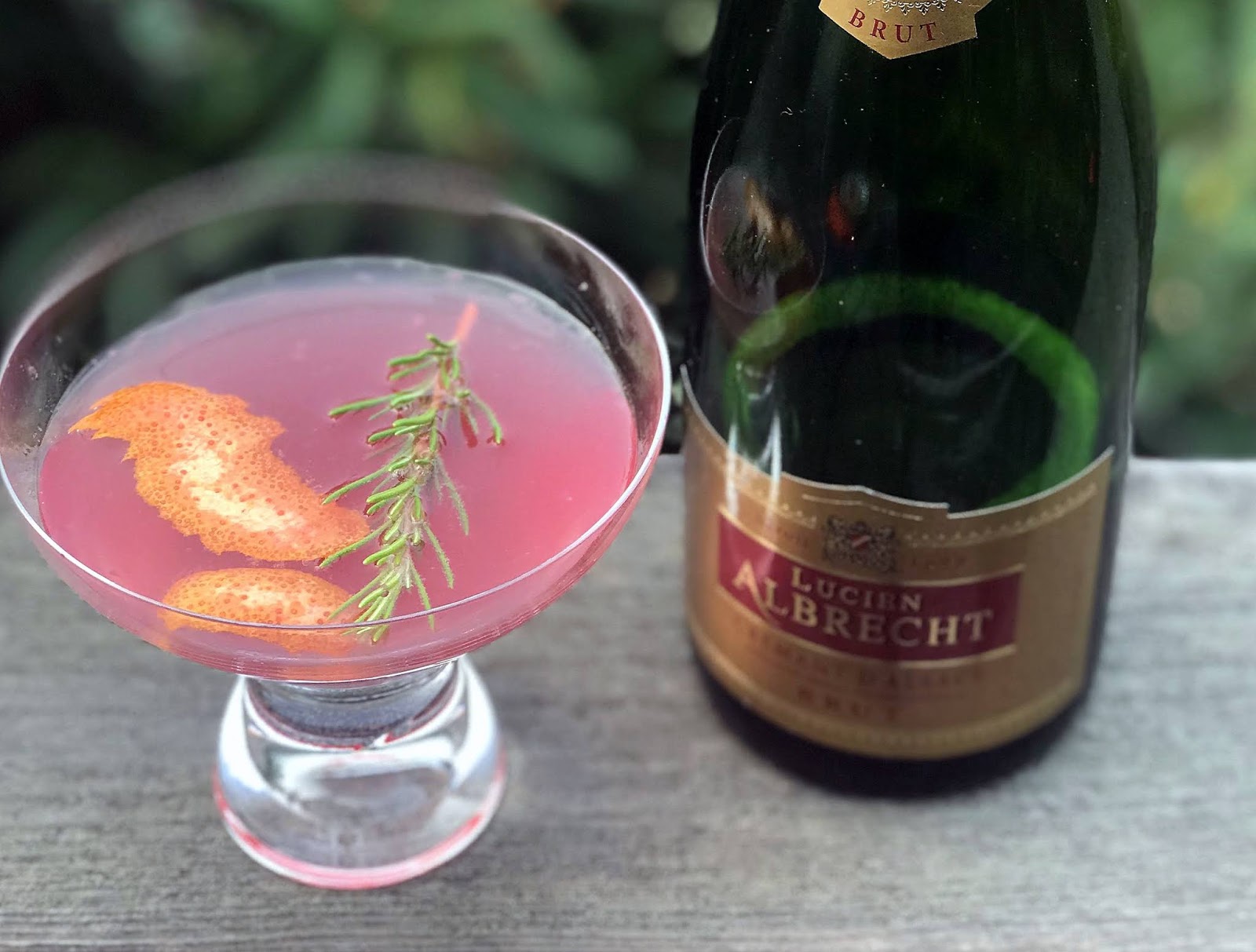
In the festive spirit, we decided to do more than just sip the wines as apéritifs or with a meal: Crémant d'Alsace cocktails! Many of the classic Champagne cocktails work brilliantly with Crémant d'Alsace - both Alsace and Champagne are far north, have the same bottle shape, and are comparable in many ways despite the soils being rather different. E.g. Champagne does not have the volcanic soil that parts of Alsace do. Nevertheless, cocktails it was!

LUCIEN ALBRECHT CRÉMANT D'ALSACE BRUT NV, SRP $21.99

The history of Maison Lucien Albrecht dates to the 15th century in southern Alsace. From then to now, they have gained a reputation as one of the premier wine makers in Alsace. Although in 2012 they joined the Wolfberger family, they continue to uphold the discerning Albrecht approach to winemaking. The Brut has fine persistent bubbles, a beautiful straw colour, and a nose full of floral aromas. Juicy acidity on the palate with toast and white flowers, a balanced wine with a medium finish. We enjoyed the delicious Lucien Albrecht blanc de blancs in two different ways: a classic elderflower cocktail and a blood orange cocktail. 

Both cocktails were excellent with the crisp fresh crémant, and the rosemary sprig added just enough resinous woodsy flavour to complement the floral notes in the wine. A combo we'd gladly do again! The cocktails come together quite quickly, making them ideal for a party of two or twenty alike! We also had a salmon, corn, and orzo pasta with a lemony dill vinaigrette - superb with the wine! Overall the Lucien Albrecht crémant is a versatile wine - equally at home with food, on it's own, or mixed into a cocktail.

GUSTAVE LORENTZ CRÉMANT D'ALSACE BRUT NV, SRP $24.99

Domaine Gustave Lorentz was established in 1836 and remains a family owned winery that has consistently upheld their vision and quality. It is also one of the most widely distributed Alsace brands, sold in 57 countries! 

The Brut is a blend of Chardonnay, Pinot Blanc and Pinot Noir. A lovely straw colour leads to small and persistent bubbles, a nose of autumn fruit like pears, and of course, the yeasty aroma of brioche. The same notes show on the palate, along with a lively minerality and smooth mouthfeel.

We made two different cocktails with this one as well: one with a bit of raw sugar and Grand Marnier, which only enhanced the other white fruit on the palate. Topped slowly with the crémant so as not to stir it up too much. A most refreshing cocktail! The other with a hint of raw sugar soaked in cognac and lemon juice then topped with the crémant.


Also see what exciting things the other Winophiles did with their crémant samples:

Liz Barrett from What’s In That Bottle is writing “Affordalicious Alsace: Best Bubbles for the Buck”

Jill Barth from L’Occasion will show us “A Festival of French Crémant”

Robin Renken from Crushed Grape Chronicles will publish “A Sparkling Rosé by any other name…just might be a Crémant”

Camilla Mann will talk about a tasting pairing, Lingcod, Legumes, and Domaine Mittnacht Frères Crémant d’Alsace on her blog Culinary Adventures with Cam.

Susannah Gold from avivinare.com will share her post “French Cremant – Perfect Sparklers for the Holiday Season” Susannah is also on Twitter @vignetocomm and Insta: @vignetocomms)

Martin Redmond will be “Elevating Weeknight Fare with Cremant d’Alsace” at the Enofylz Wine Blog

Nicole Ruiz Hudson’s post on SommsTable.com will be “Crémants for Going Out and Staying In”

Wendy Klik of A Day in the Life on the Farm is writing “Rustic Elegance; Fall Vegetable Soup paired with Cremant” which sounds perfect for Thanksgiving!

Jane Niemeyer will teach us “How to Pair Crémant d’Alsace and Food” at alwaysravenous.com

Payal Vora’s post at Keep the Peas will be called “Crémant d’Alsace: More Than Just A Sparkling Wine”

Lauren Walsh from The Swirling Dervish will “Add a Little Sparkle to Your Holiday with Crémant d’Alsace”.

Jeff Burrows will be pairing “Elegant Crémant de Bourgogne Served with Lobster Two Ways” at foodwineclick.com

Gwendolyn Alley from winepredator.com is going to be looking at Crémants from a variety of regions in her post this weekend.

David Crowley from cookingchatfood.com will be discussing the “Best Food Pairings for Crémant d’Alsace”

Rupal Shankar the Syrah Queen will be giving us “Five Reasons to Drink Crémant d’Alsace this Holiday Season”

Neil will be joining us from Eat, Live, Travel, Write with a post entitled “Champagne taste but not a Champagne budget? An exploration of France’s Crémant wines”

Saturday, September 15, 2018

WHITE WINE, RED WINE, BLACK WINE, CAHORS!

The title is a riff on the old nursery rhyme Round and Round the Garden which ends with "One step, two step, three step, bear!". Definitely unrelated to Cahors or any other wine, really. But it was on my mind and so here we are.

"France vs. Argentina" is what this blog post *should* be titled because that's the gist of malbec.

As usual, we can thank the Romans for planting grape vines literally everywhere in the Middle Ages including present day southwest France. Malbec, the intense grape that yields wine so opaque that it has earned the nickname of Black Wine, was prolific in the area around the river Lot, that is now Cahors. But because of shipping regulations that favoured Bordeaux wines, malbec never enjoyed the fame and glory that Bordeaux did even back then. The phylloxera blight in the late 19th century that wiped out nearly all of the Cahors malbec vines certainly did not help things.

While Cahors - and much of France - was dealing with that, malbec vines brought to Argentina in the mid-1800s, were thriving. And have continued to thrive to the extent that for wine, Argentina has become synonymous  with malbec, and French malbec isn't at the forefront of most malbec enthusiasts. But that is changing as more and more vintners are making wine in Cahors and making excellent cool climate malbec from grapes grown in limestone soil, quite different from the fruity ripe malbecs from Argentina.

It can take years to find limestone soil in Argentina, but it takes a few minutes in Cahors. Especially around the terraces above the river Lot, which have a thin gravel and topsoil layer with solid limestone underneath. This soil combined with the cooler climate of Cahors results in tannic wine with a delicious savoury streak. Wine that's distinctly different from the Argentine malbecs which are more supple, fruit-forward, and overall less nuanced than Cahors malbecs. 

This month with the French #winophiles we were tasting Cahors wines, and we had...

2015 CHATEAU LAGRÉZETTE SEIGNEUR DE GRÉZETTE
87% malbec, 13% merlot

Soil: limestone base, gravel topsoil, second terrace above the river Lot

Colour: Deep purple, almost opaque
Nose: Savoury, peppery, some violet, earth

Taste: Smoky, blackerries, pepper, graphite, and leather. Balanced tannins, very delicious everyday wine!

Pairing: We had this with fromage fort and figs. The fromage fort had a mix of several cheeses including blue cheese and quark. It made an excellent match for the savoury wine!

Price: $13


85% malbec, balance merlot and tannat

Soil: limestone base, gravel topsoil, second and third terraces above the river Lot

Colour: Deep purple, almost opaque
Nose: Blackberries, some violet, earth

Taste: Blackberries, pepper, and dusty tannins. Overall more fruit forward and jammy than the Lagrézette, which we preferred over this wine.

Pairing: We had this with broiled bread, fromage fort and green olive tapenade. Terrific match for this wine!

Price: $12


See what the rest of the #winophiles are saying about Cahors..

Saturday, June 16, 2018

ALSACE: A GEOLOGIST'S DREAM

This month at the #frenchwinophiles we've been all about Alsace! Another cool weather wine region in France, this time in the NE. Alsace, as we know, is in the rain shadow of the ancient Vosges mountains in NE France at the border of Germany. So on the border in fact, that it's been back and forth between Germany and France numerous times although these days Alsace is in France. I received four splendid samples of Alsace wines from the generous folks at Alsace Rocks and I've reviewed three here, the last one to come shortly.


When thinking of Alsatian wine few, if any, of us might immediately think of the paleozoic evolution of the Vosges mountains or the fact that the Rhine Valley, home to a majority of Alsace wines, was the site of Central Europe's most significant seismological event, the Basel earthquake in 1356. In fact, the Rhine Valley, so favourable to grapevine growing, is a rift valley, a zone where the the lithosphere is being pulled apart, much like pull apart bread where if you pull one section off, an adjacent piece might start to cleave off as well.  In other words, it's on a geological fault. Needless to say, the earth in Alsace has been very active for not just centuries, but millennia, and continues to be so. The granitic Vosges mountains are over 570 million years old but after their formation and well before the Rhine Valley formed, the Vosges were below sea level, and subjected to layers of sedimentitious deposits... sandstone - which is essentially pressed sand - at the bottom, limestone - which is essentially decomposed seashells next, and marl - calcium carbonate-rich clay, also sometimes called mudstone at the top.

It's safe to say that the soil in the majority of the Rhine Valley is a marble cake of calcium carbonate-based soils from various geologic eras, along with granite on the hillsides of the Vosges and volcanic soil on the other side, a remnant from the now extinct Kaiserstuhl which is no longer useful as a volcano but is home to the largest wine cellars in Western Europe.

What does all this mean vis-à-vis Alsace wine? In a nutshell, this:
  • Sandstone: elegant restrained aromatic wines, pale color
  • Limestone: sprightly fresh acidity and citrus-y juiciness to the wine
  • Marl: complex wines with well defined structure
  • Granite: lower acidity, balanced wine
  • Volcanic: aromatic wine with discernible minerality on the nose and palate

Beyond vine growing and other agriculture, geology matters in daily life. The next time you look at an old building think about what the stone is, and whether it came from a place that was below sea level at some point long ago, or from rock formed from the folding of layers of the earth, or from rock formed from soil being trapped and heated to intensely high temperatures. In forensics, we use all these clues and more to piece together the puzzle when solving problems. Geology is everywhere, and Alsace offers an entire course on it in one area!

2013 GEWÜRZTRAMINER TRADITION
DOMAINE PFISTER, http://www.domaine-pfister.com/

Domaine Pfister is a family owned and operated winemaker, seven generations strong, growing a select variety of grapes on their primarily argilo-calcareous (clay/sand-limestone) soils. The resulting wines, no matter the grape, have the bright acidity imparted by limestone (calcareous) soils and the richness and depth from the clay. And since Alsace is already a cool climate, and clayey limestone soils are cooler soils, the wine also has a delightful astringency without being overbearing.

The grapes are grown in limestone soil, and the wine has 13.5% ABV. The bouquet is fairly straightforward, not too complex, with overripe stone fruit and an undeniable whiff of petrol, but not in a bad way. On the palate it is elegant, off-dry with a medium finish, minerality, and notes of dried roses, stone fruit, and citrus.


This gewürztraminer is discernibly different from German gewürztraminers since it's drier and less sweet. We wouldn't mind a bit higher acidity, but it's excellent nevertheless with the classic pairing of muenster and petit muenster cheeses. + grapes, and dried apricots and cranberries.

We also had it with spiced elk, lemony hummus, pickled onions, peppers and cucumbers, and olives... outstanding with the wine! We also enjoyed it on its own, and at $30 it won't break the bank if you want to give it a go. You won't regret it!


2015 RIESLING "CUVÉE CHARLES"
CHARLES BAUR, http://www.vinscharlesbaur.fr/en/

The Baur family has owned the Charles Baur estate in the heart of Alsace since the early 18th century. The Riesling we sampled is fermented with indigenous yeasts and aged on the lees for several months. It is a 13% ABV wine, grown in sandy gravel soil. The wine is a beautiful pale yellow, clear with a bouquet and tasting notes mainly of citrus, citrus zest, and white flowers. It's sprightly and balanced with a medium-long finish. Not too complex a wine but still superb.


We had it with coq au riesling (chicken in riesling sauce, made with this same wine) and buttered spätzle. Perfect for a leisurely weekend dinner! At $23, this bottle is a must-buy for warm days!


2015 PINOT BLANC
CAVE DE RIBEAUVILLÉ, http://www.vins-ribeauville.com/en/

Cave de Ribeauvillé has been around since 1885, making it the oldest wine co-op (cave, kaav, is co-op in French) in France. 38 members only, and the co-op buys the entire harvest from each member, so everyone has a vested interest in the wine that comes from the co-op. This particular wine is from grapes grown on a 22.5 acre vineyard near Ribeauvillé. Jean Baltenweck, the vineyard owner, cultivates the grapes on limestone soil using organic agriculture methods with no chemical treatments, and low yields. At 12.5% ABV, this organic 2015 Pinot Blanc is a refreshing but intense wine, perfect for a warm day and a light lunch. A clear wine with a greenish-gold hue, and a gorgeous, primarily grapefruit-citrus zest bouquet with some dried stone fruit. On the palate, it's dry, not very complex or lingering, but has a mouthwatering acidity, is crisp, fresh, and pleasantly lemony. We relished it with galettes de sarrasin complète (Brittany-style buckwheat crepes, eggs, comté cheese, sautéed mushrooms) and butter lettuce with a lemon vinaigrette. Good now or within the next 3 years. Priced at <$20 a bottle this is even more 
of a winner!

All the wines we received were terrific, and we'd most certainly buy more bottles of each for the summer. Perfect to bring to a party as well!

See how the other #winophiles are enjoying Alsace and what they're saying about it:

Saturday, April 21, 2018

A LIP-SMACKING LIP-STINGER: PICPOUL DE PINET


This month the French #winophiles are in the Languedoc-Roussillon in southern France, bordering Spain, Andorra, and the Mediterranean Sea. If the geography hasn't given it away: this region is home to a variety of warm weather wines including those made from Picpoul, aka Folle Blanche. The soil - often the soul - of wine, here is primarily limestone and sand.

Limestone soil is an abundant source of plant-accessible CaCO3, calcium carbonate, and because limestone is basic, it allows greater nutrient uptake by the vines. It also has excellent water retention and drainage capacity, which allow less irrigation and less chance of water-logged soils that grapevines dislike. Calcareous (calcium carbonate-based) soil is also cooler in temperature, allowing delayed ripening of grapes. Delayed ripening in naturally acidic grapes further increases the acidity of the wine pressed from these grapes, and results in wines with a mouthwatering, delicious, acidity such as in Picpoul de Pinet or even Muscadet (melon de bourgogne) wines from the Loire Valley. A majority of these wines are best enjoyed within 3 years or so, although a rare few can be cellared for a few decades. I cant imagine why anyone would want to cellar such delicious wines that are perfect for summer and seafood!

Picpoul is not a grape commonly seen in the US, and neither is wine made from it. The one I was able to easily find was the 2016 Hugues Beaulieu (HB) Picpoul de Pinet. HB is a  cave cooperative in the Pomérols region of Languedoc. This wine has no oak, is a pale yellow colour with a green tinge. It is a "steely" bone-dry, crisp wine with juicy acidity and aromas and flavour notes of grapefruit, lemon, green apple, and salinity. The finish is medium and clean - overall a delicious wine!

As with Muscadet, the Picpoul would pair splendidly with seafood - oysters especially, or fatty river fish such as trout or eels. But it also holds well with rich dishes - ones with bechamel sauce, chèvre, or cream. Wild mushrooms are a delicacy of Languedoc and a favourite around our house, so we paired the Picpoul with croûtes aux champignons: creamy mushrooms on toast, and a green salad.


See what the other #winophiles are saying here:
  • Michelle of Rockin Red Blog says, "Picpoul...Take Me Away."
  • Wendy of A Day in the Life on the Farm encourages us to Pick a Picpoul to Enjoy al Fresco This Summer.
  • Susannah of Avvinare features Picpoul de Pinet - A Refreshing White from the Languedoc.
  • Jill of L'Occasion shares Mediterranean Bliss: Picpoul de Pinet.
  • Jeff of FoodWineClick! pairs Picpoul de Pinet and Steak Tartare Redemption. 
  • Nicole of Somm's Table writes Cooking to the Wines: Font-Mars Picpoul de Pinet with Crab Cakes and Fennel-Apple Salad.
  • Payal of Keep the Peas posts A Lip-Smacking Lip-Stinger: Picpoul de Pinet.
  • David of Cooking Chat makes a case for Picpoul Wine with Pesto and Other Pairings.
  • Lauren of The Swirling Dervish says Picpoul de Pinet: Your Go-To Wine for Spring.
  • Lynn of Savor the Harvest asserts The Single Variety Wine For Summer- Picpoul de Pinet.
  • Gwendolyn of Wine Predator has Picpoul Goes Southern with Shrimp and Grits.
  • Rupal of Syrah Queen will also have a title soon.
  • Jane of Always Ravenous pairs Halibut with Spring Vegetables and Picpoul Wine.
  • Robin of Crushed Grape Chronicles shares Picpouls from Pinet and California and a Seaside Pairing
  • At Culinary Adventures with Camilla, we're Pairing Bourride à la Sétoise with Picpoul From France to California's Central Coast.